Planning a collecting fair budget
A fair budget needs to cover the day as well as the objects. Set aside travel, admission and carrying materials before deciding what you can spend at the stalls.
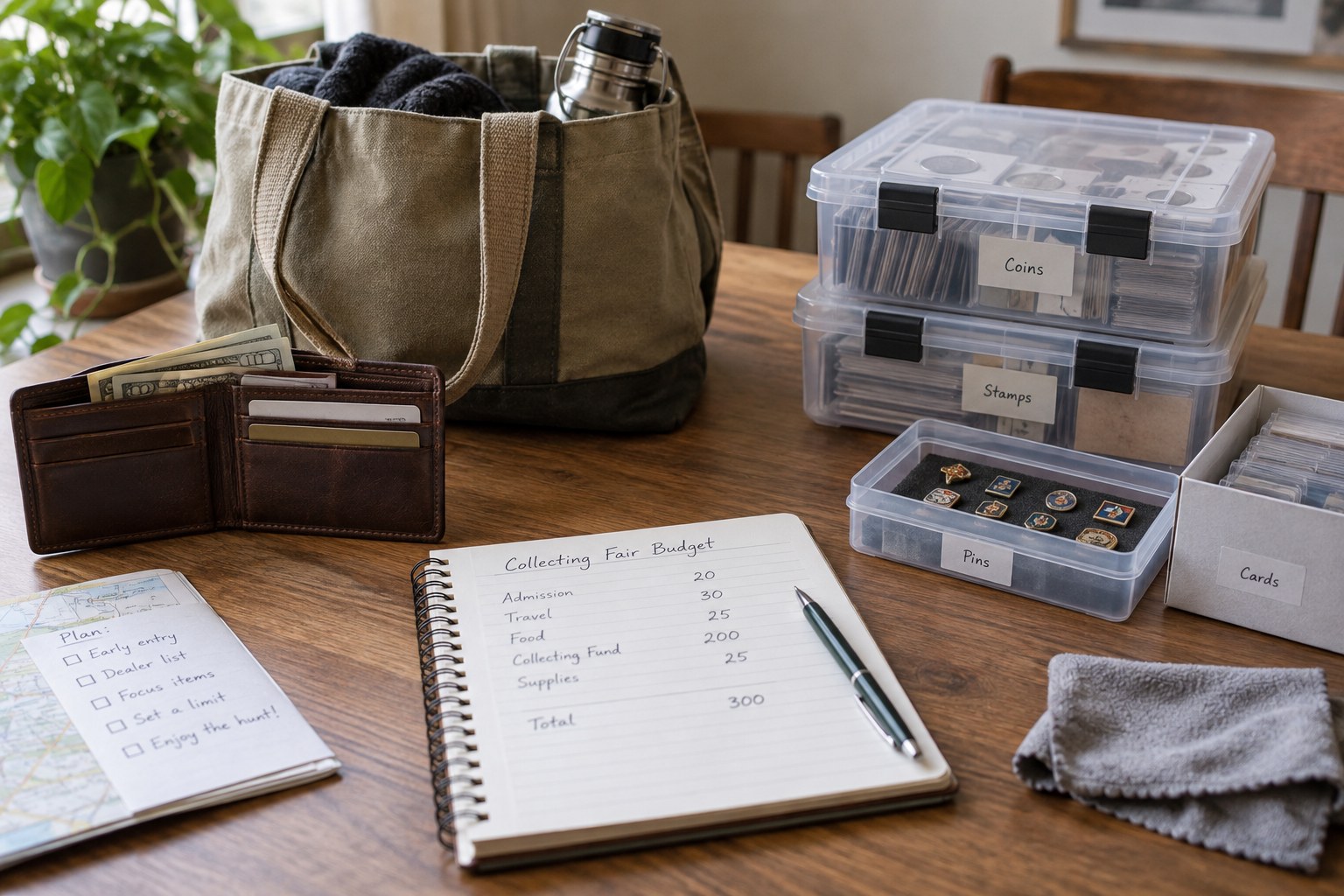
Separate the fixed costs from the collecting money
Write down costs you will incur even if you buy nothing: transport, admission, parking and ordinary food or drink. Add any accommodation already planned. Subtract these from the amount available for the visit before assigning a buying allowance. This prevents the first attractive object from consuming money needed to get home.
Keep an additional allowance for suitable enclosures or packing if purchases will need protection during the journey. A fragile model or large paper item may require more preparation than a few cards in sleeves. Check the event’s published visitor information for available facilities rather than assuming that packaging, lockers or particular payment methods will be offered.
Use a short priority list at the table
Bring the identifying details of the objects you are seeking, including acceptable variants and condition limits. For each priority, set a personal maximum total. This is a spending decision, not a claim about market value. Leave room to decline an example that does not meet the criteria even if it falls below the limit.
Photographs of objects you already own can prevent duplicate purchases, but keep them organised enough to consult quickly. A compact list of missing numbers, dates or editions is more useful than hundreds of unsorted phone images. Download the information before arriving in case the venue has poor reception.
Reserve part of the budget for unplanned interest only if you genuinely want that flexibility. Give it its own limit. Otherwise every attractive discovery can be described as an exception until the original priorities no longer have any money allocated to them.
Pause when several purchases compete
If two objects would use the same remaining allowance, compare them against your priorities rather than adding their prices and hoping the difference will resolve itself. Consider what remains uncertain about each example. One may need further research, a specialist opinion or better photographs that cannot be obtained at the stall.
Keep a running record of agreed purchases and actual payments. Note the seller’s details and the description of the item while the transaction is fresh. Do not record payment-card numbers or other unnecessary sensitive information in the collection notes. If a purchase is only reserved, mark it as a commitment so the same money is not mentally spent again elsewhere.
Leave room for the journey back
Before buying a bulky or delicate object, decide how it will travel. Ask about packing and any collection arrangement, and check the complete cost before agreeing. A low price does not solve the problem of carrying a large, unprotected object through a crowded venue or on public transport.
At the end of the visit, compare spending with the plan and record what you learned. Perhaps a priority was harder to identify than expected, or you found that storage needs limited the useful purchases. Use that information for the next fair. Returning with unspent collecting money is a valid outcome when the available pieces did not fit the collection.


