Planning how objects leave a collection
Objects can leave a collection through sale, gift, exchange or disposal. Planning the process helps preserve their documentation and prevents one decision from accidentally changing the rest of the collection.
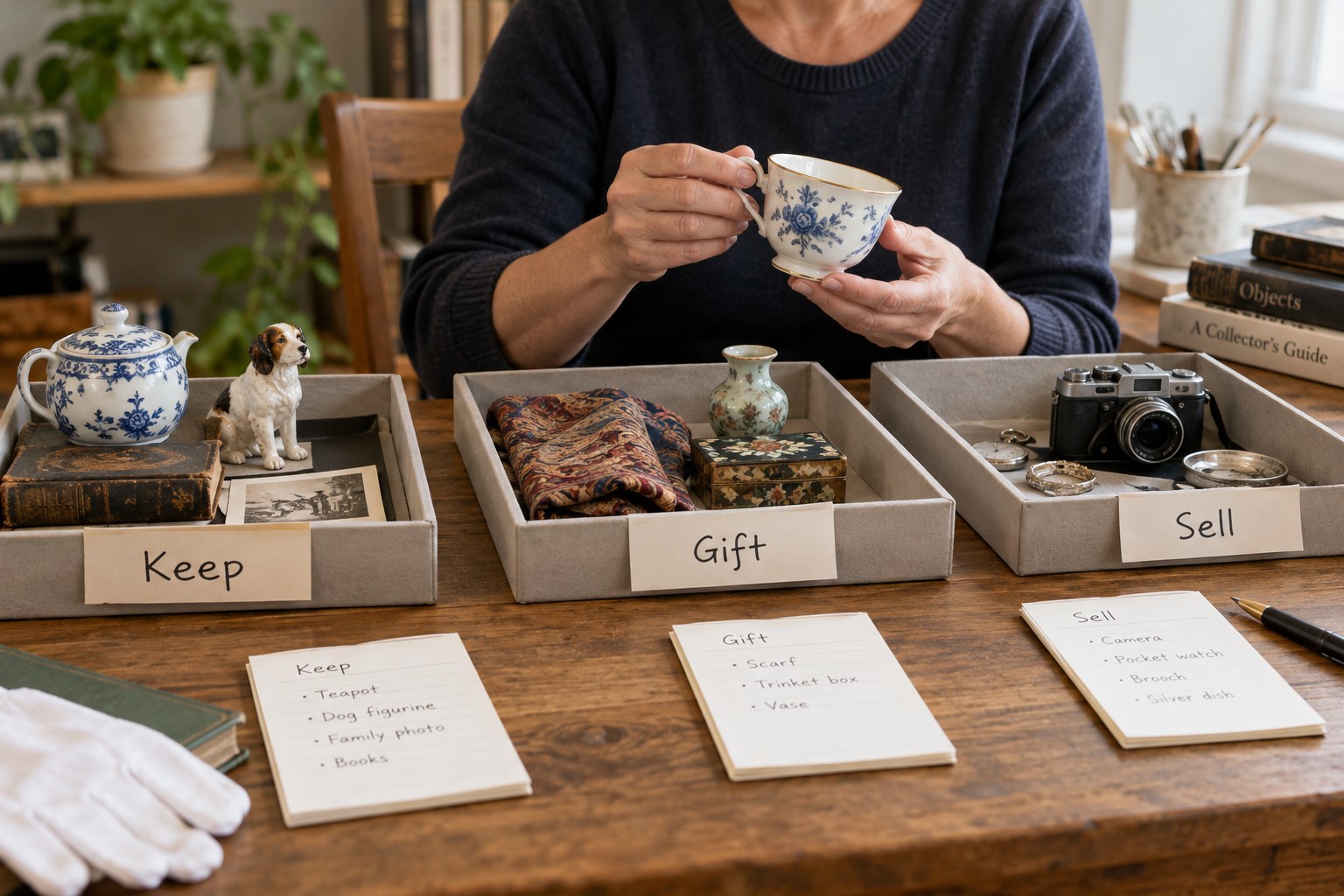
Write the reason before choosing the route
Identify why you are considering an object’s departure. It may be a duplicate, outside the revised collecting focus, difficult to store or no longer of interest. Keep that reason separate from any assumption about its value. An object can be unsuitable for your collection without being worthless, and a high asking price elsewhere does not establish what you will receive.
Check the object’s relationships. Does it belong with original packaging, a group of correspondence, a certificate or another component? If you separate related pieces, document the connection before they leave. Sometimes the appropriate unit for transfer is a group rather than the individual object that first caught your attention.
Confirm that the decision is yours to make
In a shared collection, agree the decision with the people who have an interest in it. Distinguish ownership from temporary custody: a borrowed object should not enter a sale pile because it is stored beside your own pieces. Check loan notes, family arrangements and purchase records before proceeding.
If the situation involves an estate, a disputed ownership claim or a restricted category of material, obtain relevant advice rather than assuming a general collecting guide resolves it. Record any agreed limits on transfer. Do not rely on a memory that someone once said it was fine to sell everything.
Match the route to the object and the recipient
A sale needs an accurate description and an arrangement you can manage. An exchange needs both sides to agree what is included and how condition will be assessed. A gift also deserves a clear description: the recipient should know about missing parts, repairs or storage requirements rather than receiving an unexplained responsibility.
Do not assume that a museum, club or charity will accept an unsolicited collection. Contact the organisation first, describe the material and ask about its current process. Wait for an explicit arrangement before sending objects. A donation label does not establish acceptance, suitability or any financial benefit.
For material you believe has no collecting use, check whether documents or personal information should be preserved separately. Avoid destructive disposal while identity or ownership is unresolved. When an item genuinely needs disposal, follow the appropriate local route for its materials rather than treating every collectible as ordinary household waste.
Prepare a transfer packet
Bring together the object’s identifier, current photographs, condition notes and the documents that should accompany it. Keep a copy of the descriptive record. Separate private information that does not need to travel with the piece, and make clear whether any document supplied is an original or a copy.
Agree the contents and practical handover arrangements in writing. Include accessories and packaging in the list, not just the main object. If packing or collection will occur later, mark the inventory accordingly so the item is not moved, loaned or offered to someone else in the meantime.
Leave a closed record, not an empty gap
After transfer, retain the identifier and record the date and route by which the object left. Store sensitive transaction details separately from any inventory you share publicly. Update its status and location, but do not reuse the old number for a new acquisition.
Review whether the departure changes the collection’s remaining records. A group photograph may now show an object no longer present; a shelf label may need updating; a wish list may contain a replacement goal. These small changes close the process and let the next person understand the collection as it now exists, while preserving the history of what came before.


