Recognising missing evidence in a listing
A listing can be detailed and still omit the evidence needed for its main claim. Identify which statements are supported, which depend on the seller and which remain unresolved.
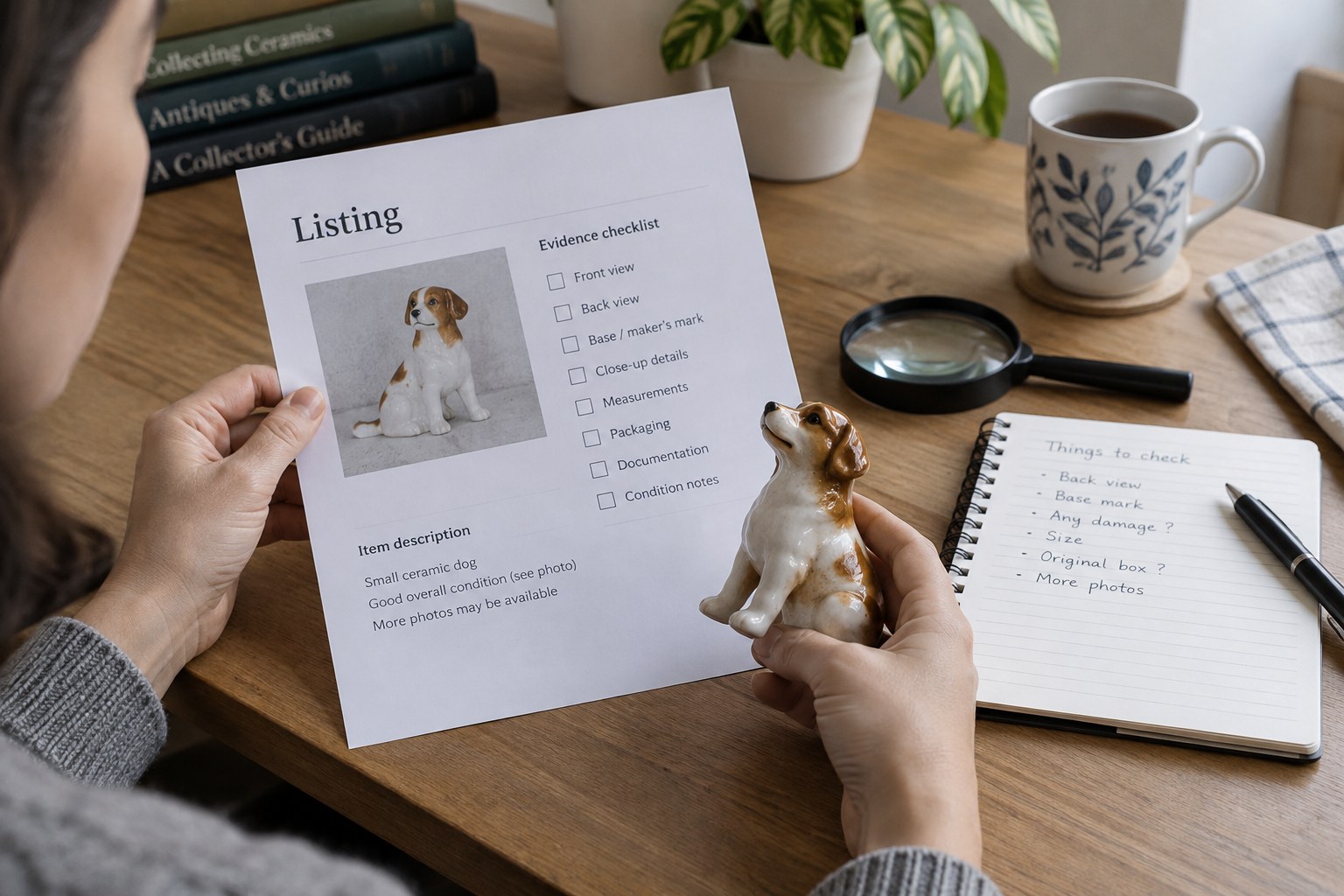
Match each important claim to evidence
Read the listing once for its overall description, then again for claims that affect your decision. Terms such as complete, original, first edition, signed or working each raise different questions. Write down what would allow you to assess the particular claim: a component list, publication details, a documented history or a clearly described test.
Compare that need with the actual material supplied. A photograph of the front cannot establish the condition of the reverse. A box label may identify a product but not prove the model inside belongs to it. A certificate photograph may show wording without demonstrating that it relates to the exact object offered. Keep the connection between claim and object explicit.
Notice substitutes for the missing information
Repeated adjectives, a long story or many similar photographs can make a listing feel informative without answering the relevant question. Ten front views still leave the underside unseen. A general statement about a manufacturer's reputation does not establish the condition of this copy. Separate the volume of material from its usefulness.
Stock photographs are valuable for recognising a product but cannot document wear or repairs on an individual example. A seller's own photograph is more relevant to condition, although it can still be blurred, cropped or incomplete. Do not assume an image answers a question merely because it appears beside the claim.
Ask for the smallest useful addition
Request a specific view, transcription or explanation that would resolve the gap. For completeness, ask for the included components; for a publication claim, ask for the relevant printed information. Avoid demanding unsafe disassembly or a guarantee the seller cannot reasonably provide. The request should target evidence, not pressure someone into sounding more confident.
Evaluate the answer against the original question. If the seller repeats the claim without supplying the requested evidence, the gap remains. If they explain that the information is unknown, that is a clearer basis for a decision than an unsupported assurance. Keep the reply with the listing so the uncertainty is not forgotten later.
Make a decision that includes the gap
Some missing information may be acceptable for an inexpensive study object or a display purchase with limited expectations. The same gap may be unacceptable when identity, completeness or condition is central to the price. Decide based on your actual purpose and budget rather than a fear of missing the opportunity.
You can pause or decline without proving that the listing is false. Absence of evidence is not automatically evidence of fraud, but it is still a limit on what you know. If you proceed, preserve that limit in the inventory instead of turning a speculative purchase into a confidently attributed object after arrival.


