Choosing boxes by internal dimensions
A box can look generous on a shelf and still be too small inside. Measure the contents as they will actually be stored, including their individual enclosures.
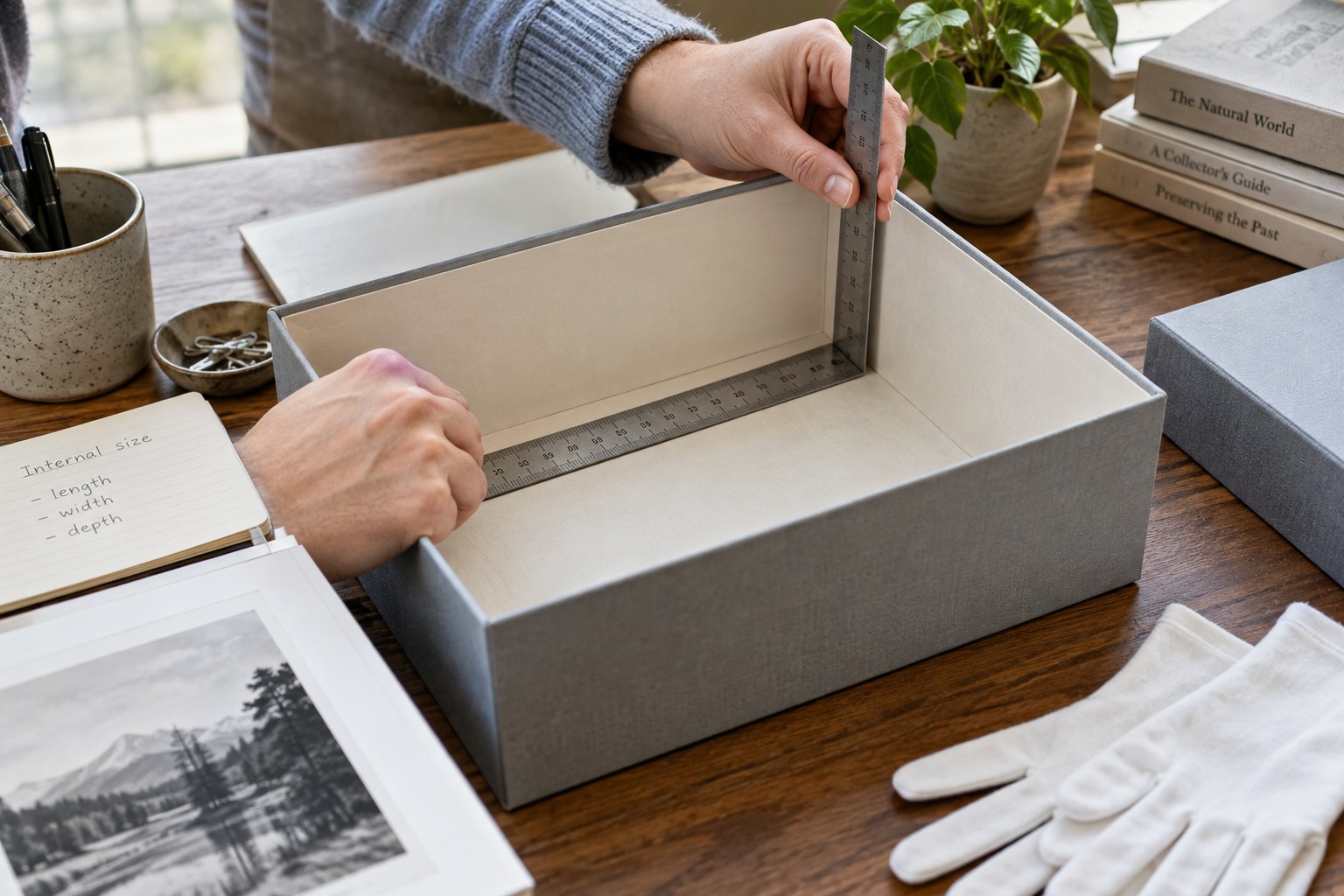
Measure the stored arrangement
Lay out the objects in the orientation you intend to use. A postcard in a sleeve is larger than the bare card; a model on its base is taller than the model alone. Record the largest dimensions of the protected objects, not just the average size. If dividers or supports are needed, include their thickness in the layout.
Do not count on bending a sleeve, leaning an object against its neighbour or pressing down a lid to make a tight arrangement work. Leave space for removing one item without dragging it across another. The necessary margin depends on shape and handling: a stack of flat folders and a model with a fragile mast do not need the same arrangement.
Read dimensions as a three-part specification
Check whether the seller gives internal or external length, width and height. Ask which dimension describes the opening and whether a lid, rim or handle intrudes into the usable area. A box may be wide enough at its base but narrower at the top, particularly when sides taper for stacking.
Make a paper footprint of the proposed interior and place empty enclosures on it before putting collectibles inside. For height, a simple card marker beside the arrangement can show where the lid would sit. This is a planning check, not permission to build storage from unidentified cardboard or other materials that will touch the collection.
Check the box outside the box
Now compare external measurements with the shelf or drawer where the box will live. Include the space needed to grasp it and open its lid. A container that fits only when wedged between other boxes will be awkward to retrieve and may encourage people to pull on weak handles or corners.
Estimate the loaded weight before choosing a large format. Several smaller boxes can be easier to move than one deep container filled with dense objects. Check the box and shelving specifications rather than assuming that a tidy fit means an adequate load capacity.
Order a small trial quantity when the supplier’s measurements or material information leave room for interpretation. Test an empty box, then a representative arrangement, before reorganising the whole collection. Keep the supplier’s specification with your storage notes so a later order can be compared with what actually worked.


