Lighting a collection without continuous exposure
A collection does not need to be illuminated when nobody is looking at it. Plan the viewing schedule as carefully as the position of the lamps.
Start with the objects’ sensitivity
List what is on display, including paper labels, packaging and photographs alongside more robust objects. A mixed display should not be planned only around its least sensitive component. The Library of Congress warns that light damage to paper is irreversible. Ask a conservator for advice when the materials or their display tolerance are uncertain.
Look at daylight as well as artificial lighting. A case near a window may receive changing exposure throughout the day even when its own lamp is switched off. Observe the location at different times rather than judging it during one evening visit. Moving the display may be more useful than adding another accessory to an unsuitable position.
Make illumination deliberate
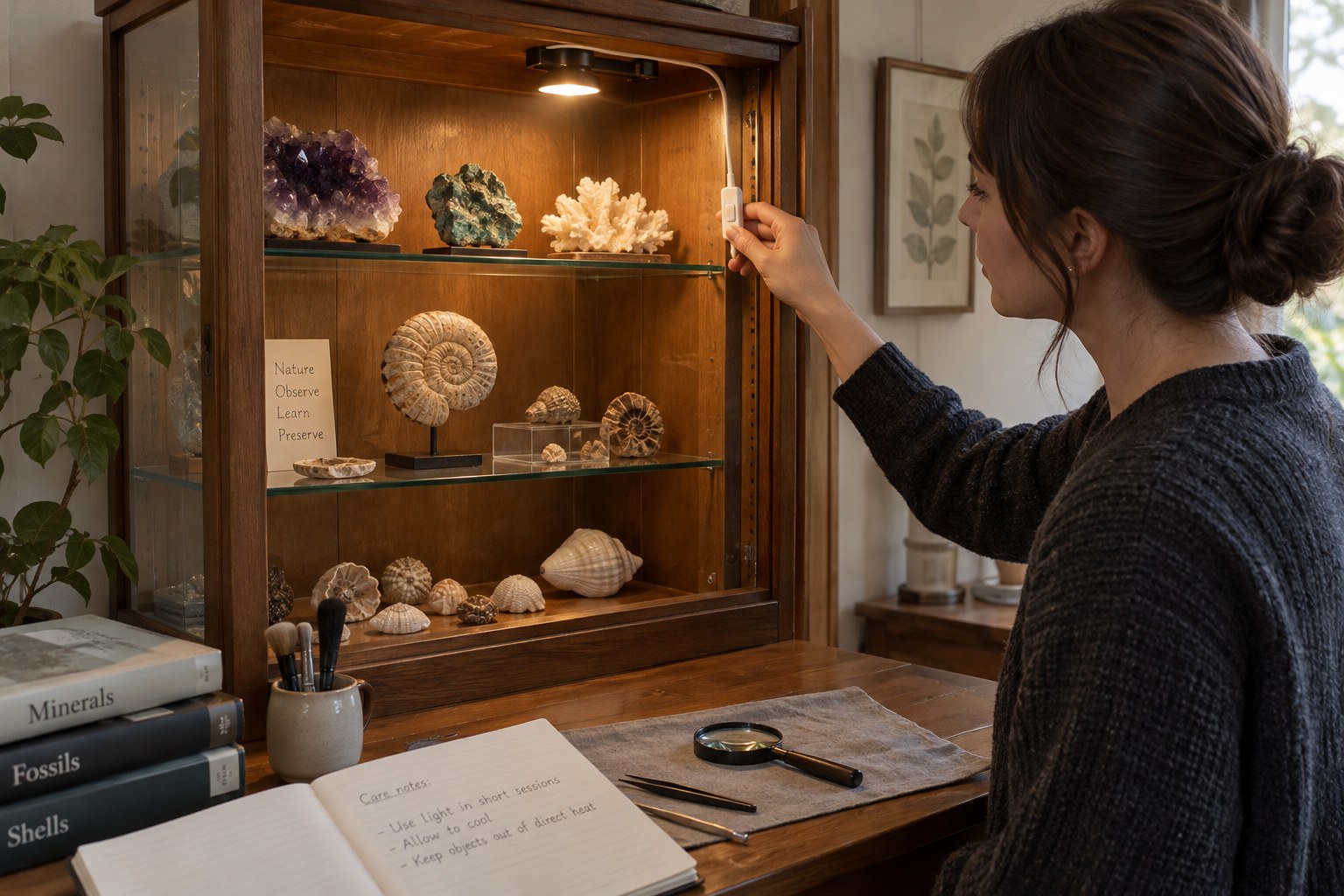
Place the switch where you can use it without reaching over the collection. A timer or other control can help limit forgotten lighting, but test that it actually turns the intended lamp off. Keep the setup understandable to other people who use the room. A complicated control that nobody remembers may not support the routine you intended.
Choose lighting equipment according to the fixture’s specifications and obtain suitable installation help where needed. Consider glare, access and any heat near the case. Do not position a lamp so closely that changing it risks touching the objects. Test the arrangement with an empty case or substitute display before introducing sensitive material.
Use copies when the image is the main purpose
For a frequently viewed paper image, a clearly identified reproduction may satisfy the display purpose while the original remains in appropriate storage. Keep the copy and original linked in the inventory. Do not allow the displayed reproduction to become confused with the original when the arrangement is later dismantled or offered to someone else.
If rotating original objects, record the dates and locations so exposure history is not lost. Rotation is a management choice, not proof that a particular schedule is safe for every material. Obtain advice for sensitive pieces and preserve the limits of what you know.
Check the routine after installation
Observe whether the lights are left on unintentionally, whether sunlight reaches the case and whether labels remain readable without increasing brightness. Adjust the arrangement around actual use. The objective is a view that serves a person at a particular time, with the collection returned to its intended storage conditions when that viewing ends.


