Planning shelves around weight and access
A shelf plan needs to explain how the collection will be lifted, opened and returned. Available length alone does not tell you whether the arrangement is usable.
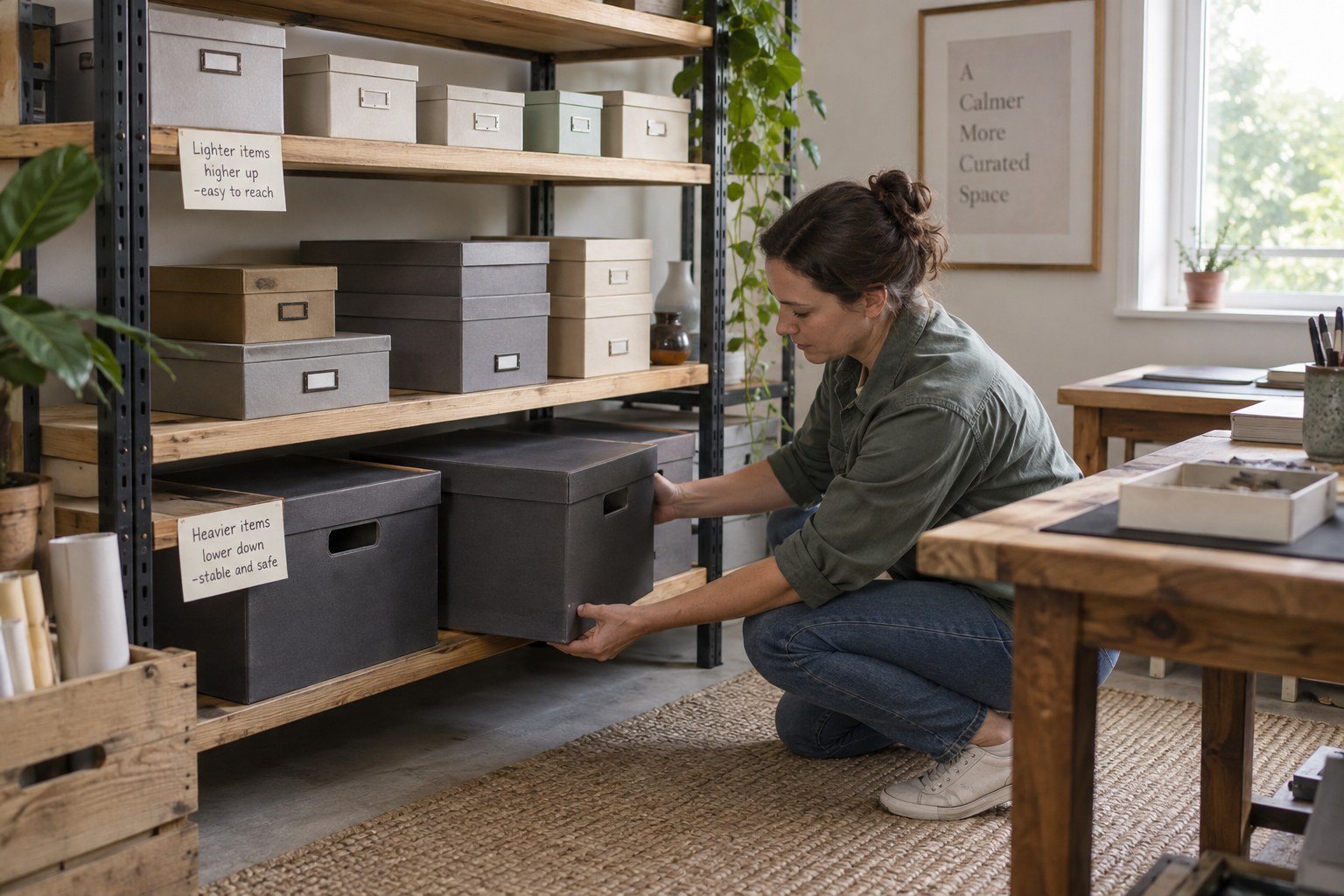
Measure the filled containers
List the boxes, trays and cases that will occupy the shelf, including their filled weight where it can be established safely. Use the exterior dimensions and account for lids, handles and labels. An empty box can give a misleading impression of how easy the loaded container will be to move. Do not create a large container simply because it reduces the number of labels.
Check the shelving manufacturer’s load information and assembly requirements for the exact unit. Distinguish a rating for one shelf from a rating for the whole structure. Where fixing or installation is required, follow the supplied instructions and obtain suitable help. Do not estimate structural capacity from the apparent thickness of a board or from how another shelf has behaved.
Plan the reach and lifting route
Put frequently consulted material where it can be reached without stretching over other objects. Consider the weight and shape of each container, not only its frequency of use. A heavy tray that must be lowered from above shoulder height creates an awkward routine. Arrange the collection so normal access does not require balancing one box while moving another.
Measure the space in front of the shelf and the route to the work table. Doors, chair backs and narrow corners can interrupt an otherwise sensible plan. Check whether the container can be turned and set down with both hands available. If two people are needed for a particular object, record that fact and leave enough space for both.
Keep a clear staging area near the shelving for a container that must be moved temporarily. Without one, rearranging a row can turn into placing boxes on the floor or balancing them on another case. Include that staging space in the room plan.
Keep the shelf order visible
Give each shelf a location code and each container a readable label facing the access side. Keep the contents index outside closed boxes. If a box temporarily moves, update the record rather than leaving the location as an assumption. Avoid using every spare gap for unrelated packaging, which can block access and hide labels.
Trial the arrangement with a few representative containers before filling the unit. Retrieve a low box, a high box and the largest case, then return them. Notice whether lids catch, neighbouring objects shift or fingers lack clearance. Adjust the plan around those observations. A storage layout is successful when retrieval remains controlled after the collection is in place, not merely when everything fits on installation day.


