Recording dimensions of irregular objects
An irregular object needs more than a single length. Record the outer envelope, the projecting details and the orientation in which each measurement was taken.
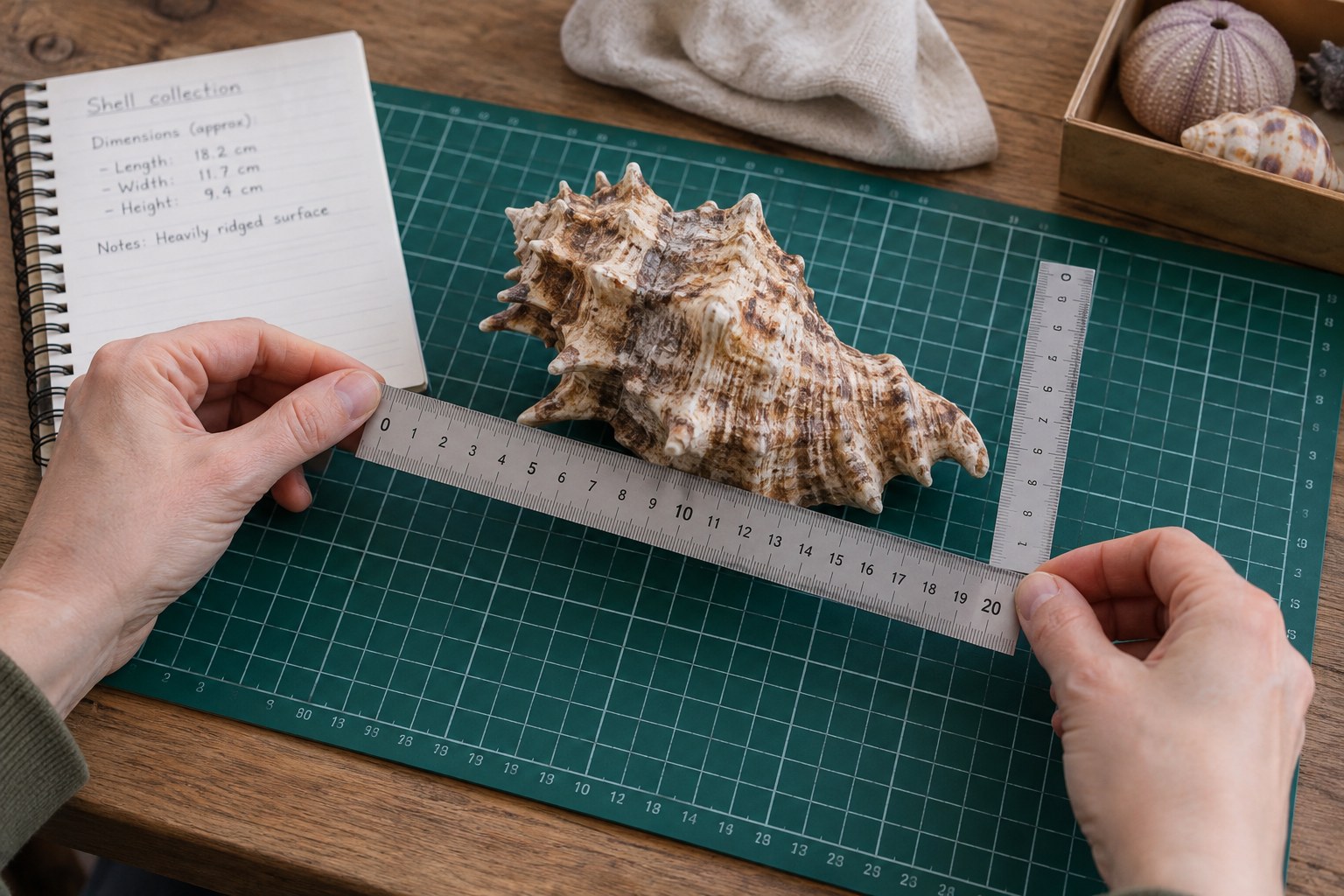
Choose a stable reference position
Place the object on an appropriate support in the position it will normally occupy. Record that orientation with a photograph. A measurement taken with a movable part extended may differ from one taken with it folded, so state the position rather than treating both as the same dimension. Do not move a resistant component simply to obtain a smaller size.
Identify the greatest length, width and height, including projections. A base, handle, aerial or raised label can determine the required space even when it looks secondary to the main shape. Keep separate measurements for the object and any complete assembly that travels or displays with it.
Measure without using the object as a stop
Bring a ruler alongside rather than pressing it against a delicate surface. Use a suitable method that does not require balancing the object or trapping it between hard edges. For a complex or fragile form, seek advice before attempting contact measurements. Record an approximate measurement as approximate instead of adding unsupported decimal places.
A photograph with a scale beside the object can help explain the measurement, but perspective may affect apparent size. Do not rely on an angled photograph as the only dimensional record when ordering a close-fitting case. Supply the measured values and explain which points define them. Include a simple sketch if it communicates an unusual projection more clearly.
Repeat a measurement when the reading depends on an awkward viewing angle. If the two results differ, explain the uncertainty to the case supplier instead of selecting the smaller value to obtain a tighter fit. Clearance decisions should account for what the measurement can actually support.
Translate dimensions into storage requirements
The outer dimensions are not the same as the space needed to place and remove the object. Consider hand access, cover movement and supports. A case with exactly matching internal dimensions may be unusable. Ask the supplier about usable clearance at the relevant height, especially if walls slope or the opening is narrower than the base.
Keep the measurement date, orientation and method with the inventory. Update the record when a base or display arrangement changes. Retain earlier dimensions when they explain an old case or transport plan. The aim is a record another person can use without guessing whether a protruding part, support or handling allowance was included.


