Tracking humidity changes in a storage area
A humidity record is most useful when it explains where the measurement came from and what happened nearby. One isolated reading cannot describe a room’s behaviour.
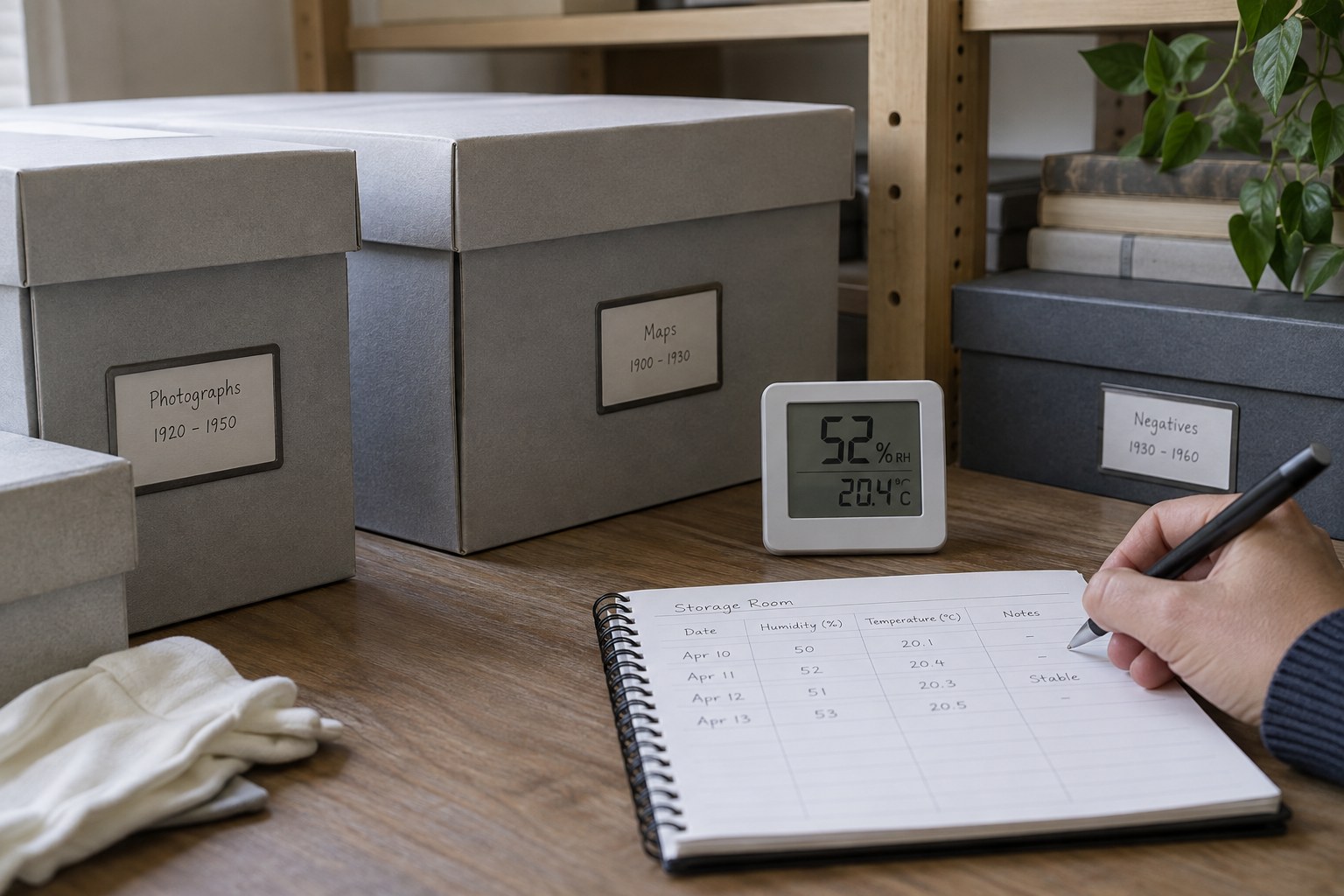
Define the question before buying a monitor
Decide whether you are comparing locations, investigating a suspected seasonal problem or checking changes after moving a collection. That question determines how long you need to observe and where the instrument belongs. A device beside a window may describe that spot well while saying little about the inside of a cabinet across the room.
Choose an instrument with a stated measurement range, accuracy and recording method appropriate to the task. Read its instructions for setup, placement and checks. Display resolution is not the same as accuracy. Keep the model and device identifier in the record so data from two instruments are not combined as though they came from one unchanged source.
Record location and time consistently
Give the monitoring position a name and photograph its placement. Note whether it is in the room, inside a cabinet or inside an enclosure. Avoid moving it between positions without recording the move and time. A sudden change in the graph may otherwise appear to describe the collection when it actually describes a new measurement location.
Set the clock and time zone correctly and check how the device exports dates. Keep temperature readings alongside relative humidity when the instrument provides both. Save the original data files and make analysis copies separately. If recording manually, use a consistent schedule and acknowledge that readings between visits remain unknown.
Keep an event log beside the numbers
The Canadian Conservation Institute recommends noting unusual circumstances such as power failures or maintenance when monitoring temperature and relative humidity. Apply that principle to the room you actually use. Record a prolonged open window, heating changes, a leak or relocation of storage when relevant. Do not assume a pattern has a cause merely because the two occurred near each other.
Review the data for gaps, implausible jumps and low-battery periods before interpreting it. If a reading seems surprising, check the instrument and location rather than immediately changing the environment. A second appropriate measurement may help investigate, but disagreement between devices also needs explanation. Keep both readings instead of selecting the one you prefer.
Use the record to seek an appropriate response
Different materials and conditions have different vulnerabilities, so avoid treating one universal target as suitable for every collection. Bring the time series, object descriptions and event log to a conservator when you need advice. Ask what change, if any, is justified and how its effect should be evaluated.
After an agreed change, continue monitoring in a comparable way and record what was altered. A short improvement does not establish year-round performance. Preserve the limits of the observation period when describing results. The monitor supports a decision by showing patterns; it does not itself control the environment or certify that the collection is safe.


