Understanding model scale and actual size
Scale describes a relationship to the full-size subject. It does not tell you the exact shelf space a model needs, and it should not be confused with a model railway's track gauge.

Read the ratio as a comparison
At a stated scale of 1:50, one unit on the model represents fifty of the same units on the full-size subject. A five-metre vehicle would therefore be about ten centimetres long at that scale, before allowing for how the model is represented. Keep the units consistent when calculating: dividing centimetres by the scale denominator gives centimetres, not millimetres.
A larger denominator means a smaller model of the same subject. That last qualification matters. A large real vehicle represented at 1:100 can still be longer than a small real vehicle at 1:50. Comparing scale labels alone cannot tell you which box or cabinet is required when the subjects differ.
Check the physical model
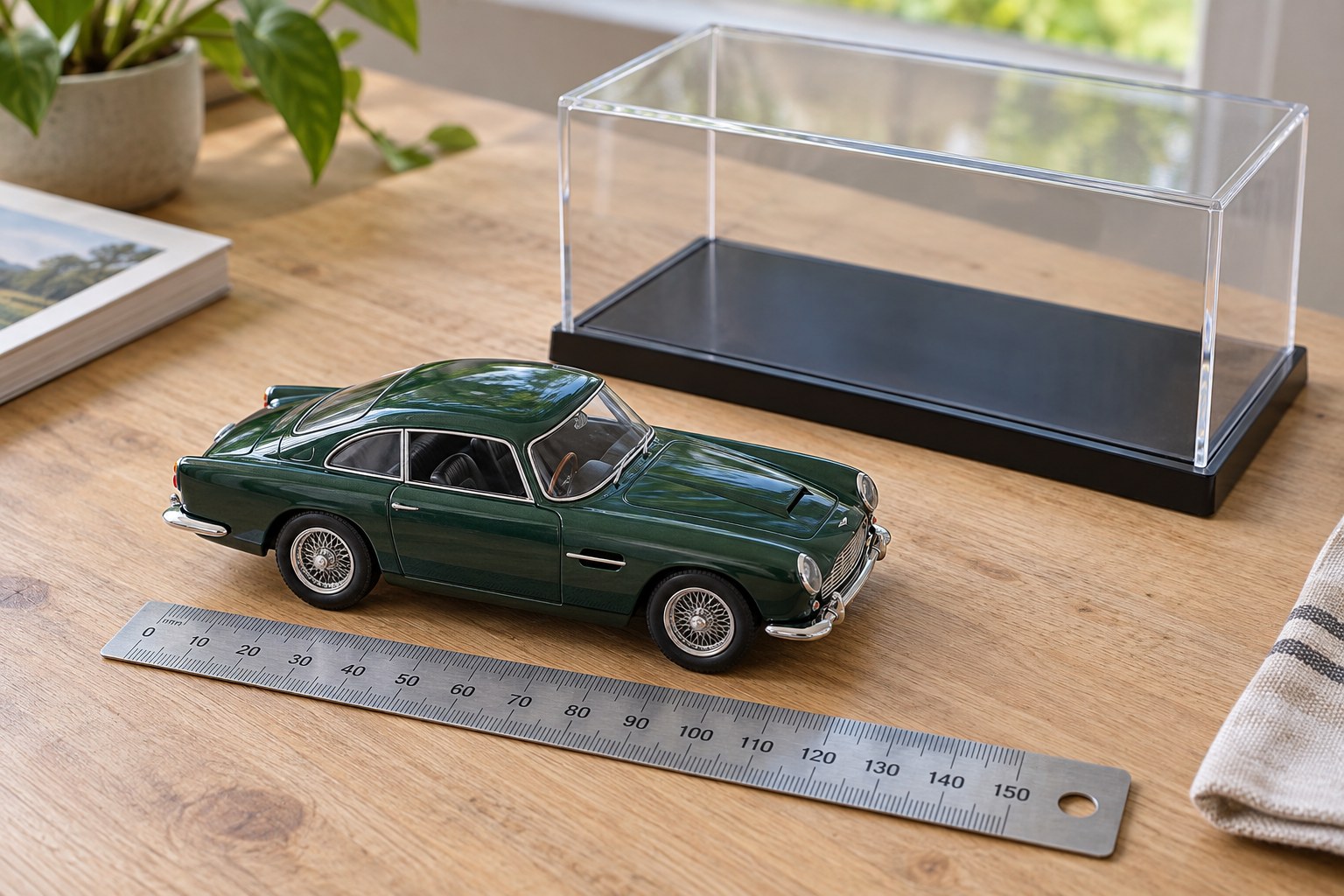
Ask for the actual length, width and height of the assembled model. Include mirrors, aerials, wings, weapons or other projecting parts, depending on the subject. A base or stand may determine the footprint even when the model itself is narrow. If parts can be positioned differently, request measurements in the arrangement you intend to display.
Some toys use simplified proportions or are designed around packaging and play features. A listing that calls an object scale-like or approximately a particular scale may not promise an exact dimensional reduction. Record the wording and the source of the scale claim. Do not turn a rough estimate into a precise catalogue fact merely because it resembles other models on the shelf.
Keep railway gauge separate
In model railways, scale and gauge answer different questions: scale concerns the model's proportions, while gauge concerns the distance between the rails. The National Model Railroad Association explains this distinction in its beginner material. Models sharing a gauge are not automatically the same scale, and a scale name alone does not establish electrical or mechanical compatibility.
If you intend to operate a train rather than only display it, ask separately about track, power and control requirements using the maker's documentation. Do not connect an unfamiliar model simply because its wheels appear to fit a piece of track. For a display-only purchase, still record gauge and scale separately so a future owner can understand the description.
Use measurements for the buying decision
Draw the intended footprint on paper and place it within the shelf's usable area. Add space for safe handling and any protective case. Compare that physical arrangement with your collection plan: a consistent scale may be important for a scene, while a mixed-scale display may be entirely appropriate for a thematic collection.
Save both the stated scale and the measured dimensions. The first helps describe the model; the second helps you house it. Keeping both fields avoids repeatedly recalculating a size that the actual object, its base or its projecting details may not match exactly.