Checking banknote sleeve measurements
A banknote sleeve needs room for insertion as well as room for the note itself. Compare the usable opening before ordering a pack for an entire collection.
Measure the complete object
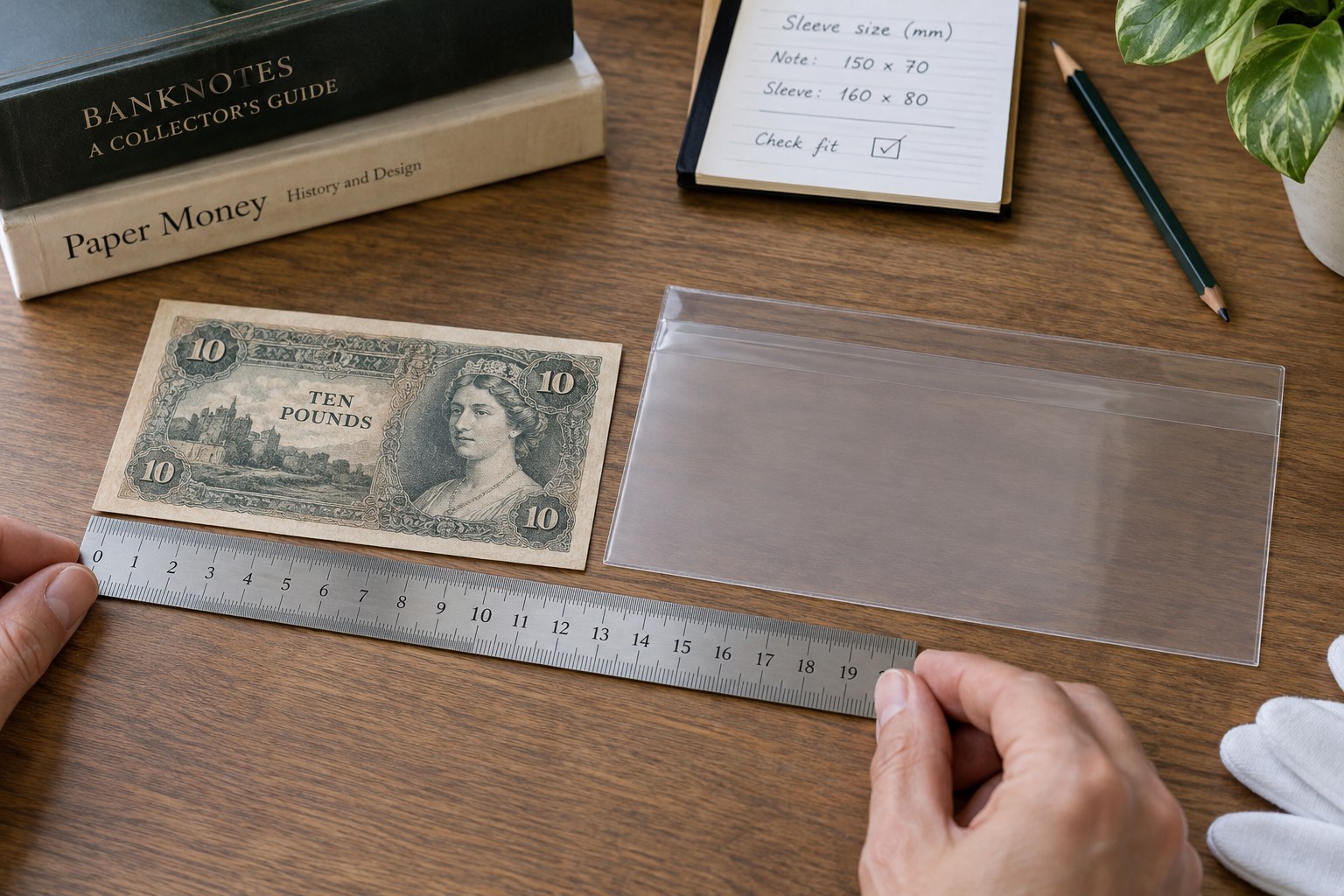
Record the note’s greatest width and height without pulling it straight. Include any projecting corner or existing attached element that will remain with it. If the note is folded or distorted, do not flatten it merely to make the measurement easier. Describe that condition when asking a supplier or conservator about an enclosure. A nominal catalogue size may not describe the object in front of you.
Make a paper rectangle matching the dimensions for your shopping comparison. This lets you assess a proposed pocket without repeatedly using the banknote as a gauge. Mark the side from which the note would enter. A narrow opening can make an otherwise large pocket unsuitable, especially when an object needs support throughout insertion.
Distinguish the outside dimensions from the usable cavity and the opening. Seams occupy space, and a flap can reduce access. Ask the supplier for internal measurements if only an overall size is published. Check whether the product is a single sleeve or a multi-pocket page: the latter must also fit the binder and permit pages to turn without bending the contents.
Check the enclosure as a system
A close fit can look tidy while making removal difficult. You need enough clearance to insert the note without catching its corners, but not such a large unsupported pocket that it moves freely whenever the page turns. There is no single margin that suits every note and construction. Test the dimensions with the paper substitute and obtain advice for fragile examples rather than forcing a fit.
Ask for the actual plastic specification and any coating or adhesive used. A clear appearance and a label saying collectible do not identify the material. Keep supplier information with the inventory’s storage notes so you know what contacts the object. If a paper support is needed, its thickness must also be included in the fit calculation.
Finally, check where the identification will sit. A label attached to the outer enclosure should remain legible without obscuring the design or touching the note. Use one sleeve for a trial before replacing the whole system. Retrieve it from the intended box or album, view both sides and return it. That ordinary sequence reveals problems an empty product photograph cannot show.