Choosing a coin album with suitable openings
An album opening must fit the object you store, which may be a capsule or holder rather than a bare coin. Check a complete page before committing to a system.
Choose between a fixed sequence and flexible pockets
A preprinted album can organise a defined series clearly, but its spaces also impose a collecting boundary. Check the issues and variants actually represented before buying. A blank pocket page offers more flexibility, though you must supply the labels and sequence yourself. Decide whether the printed structure supports your collection or encourages purchases simply to fill empty holes.
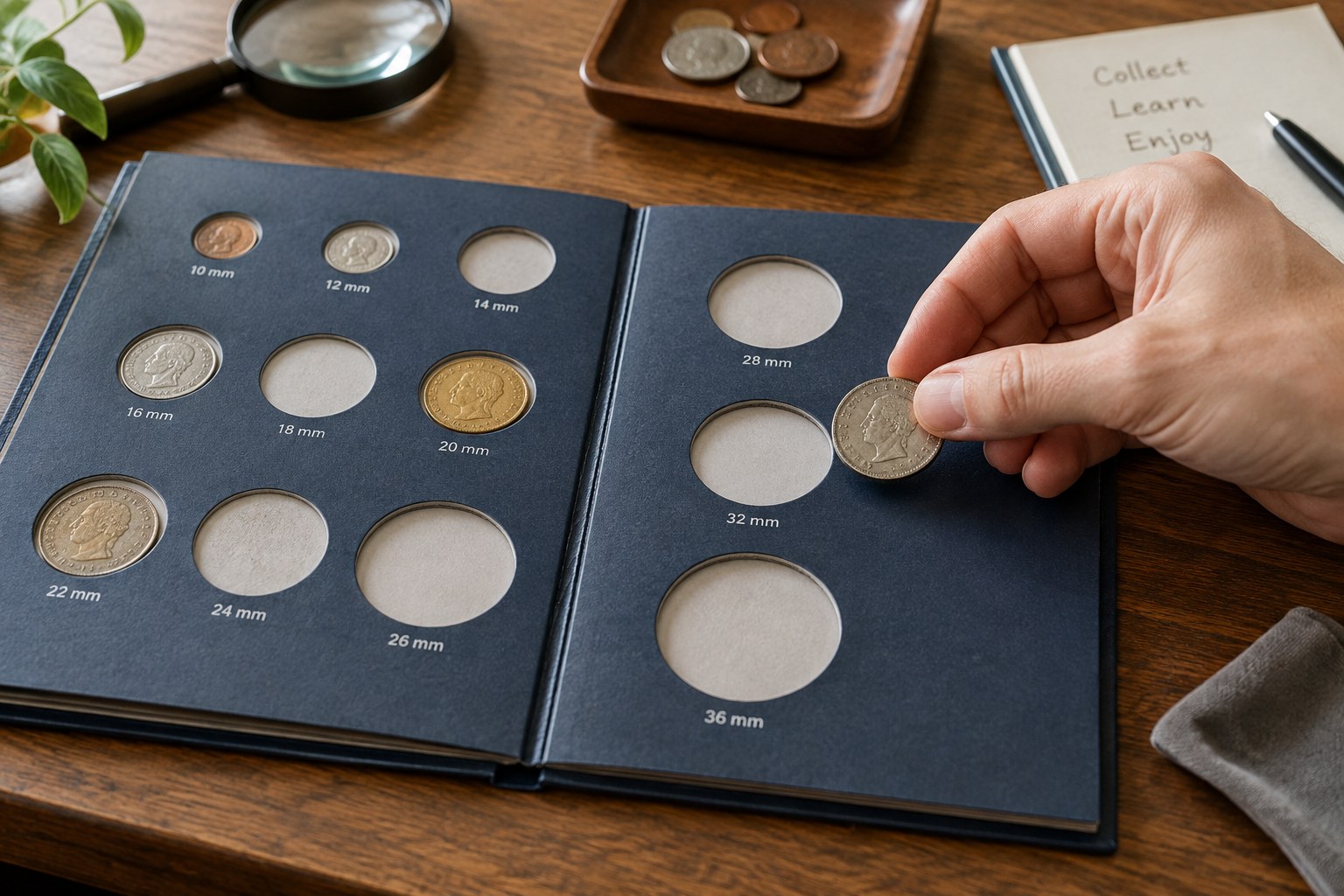
Make a list of the largest and thickest examples the album must accommodate. Include their protective holders where applicable. A product described by coin diameter may be intended for direct insertion, while a pocket page may be sized for an outer holder. These are different systems. Ask exactly what the stated opening measurement describes and how the object is retained.
Test insertion and page turning
Use an empty holder or a paper substitute to assess the opening before introducing a coin. Check whether corners catch, whether the pocket closes and whether removal requires pulling on the object. An exact fit on paper can still be awkward when seams and page curvature reduce access. Do not force a coin into an opening that seems slightly too small.
Look at the complete page, not one empty pocket. Several thick capsules can make it difficult to turn a sheet or close a binder. Ask about the intended page capacity and leave space for normal movement. Overfilling can turn a flexible page into a heavy, uneven panel. If the album must lie open while viewing, make sure the table supports the pages rather than leaving loaded sheets hanging.
Request material information for the parts that contact the coin or holder, including windows, backing and adhesive. A decorative cover tells you little about the interior. Keep the specification so replacement pages can be compared later; a product with a similar name may not have the same construction.
Plan labels and exceptions
Reserve a readable place for inventory numbers without covering the design. Decide how you will record a coin removed temporarily for photography or assessment. A placeholder card can prevent the gap being mistaken for an empty space available to another piece. Keep the coin’s permanent ID independent of its changing page position.
An oversized or unusually thick object does not need to be forced into the album to belong to the collection. Store it appropriately elsewhere and insert a reference card giving its photograph and location. The album then remains a useful index while the physical storage respects the actual dimensions of each piece.