Documenting repairs to collectible toys
A repair record should let a future reader understand what changed, who did the work and what remains uncertain. It is useful even when the intervention was small or happened before you owned the toy.
Record the starting condition
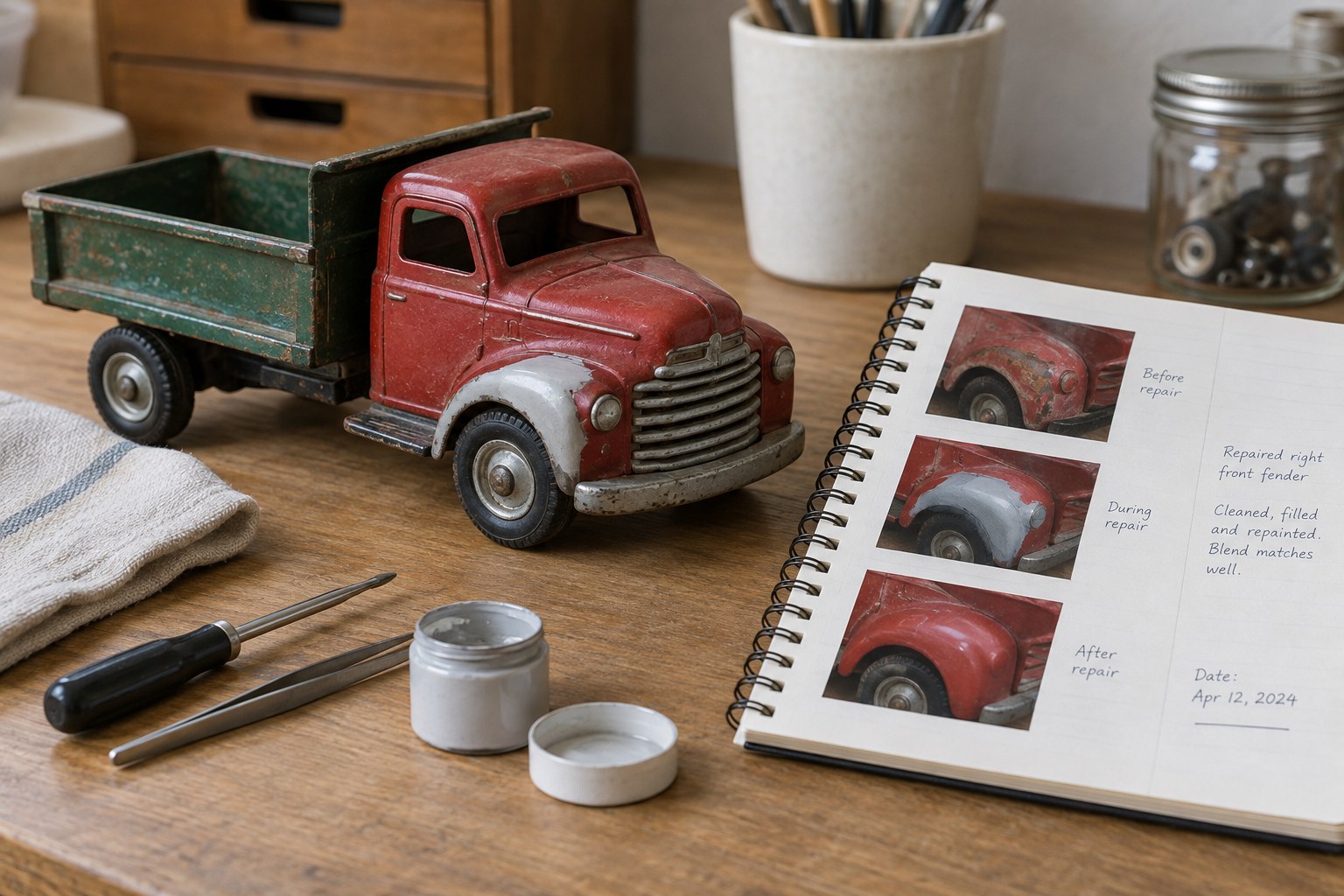
Give the toy an inventory identifier and photograph the whole object before any work. Add views of the damaged area and any detached pieces. Describe what you can see in neutral terms: a detached wheel, a crack beside a fixing or a missing strip of paint. Do not assume the cause or age of the damage unless there is evidence for it.
If the toy has already been repaired, make the record from the present condition and say that no earlier photographs are available. Ask the previous owner or repairer for documentation, but keep their account attributed to them. A later recollection can be helpful without becoming a contemporary treatment report.
Describe the scope before work begins
Write down the intended outcome. Reattaching an original part, replacing a missing part and repainting a surface are different interventions. State which components are involved and whether the proposed work will alter visible appearance, movement or materials. This helps prevent a request for a small repair from quietly expanding into a larger restoration.
For professional work, ask for a written description of the proposed treatment and any limitations. Include who will authorise changes if the initial examination reveals a different problem. Keep estimates and agreements with the inventory record, but separate financial details from the factual account you might later share with another collector.
Keep a dated account of what actually happened
Record the date, person or business carrying out the work and the steps they report. Where materials are documented, preserve their exact names and product references. Do not invent an adhesive type from its colour or describe a material as reversible unless that is a supported statement from the professional responsible.
Photographs during the work can be valuable when obtained without interrupting safe handling. Label them by stage rather than mixing them with the finished views. Keep detached original components and replacement packaging when appropriate, linking them to the toy. A replacement part should not erase the history of the original part simply because the final appearance is tidy.
If the plan changes, record the reason and the new scope. For example, a component found to be a previous replacement may require a different decision from an original broken component. The record should make that decision visible rather than presenting the final state as though it had been the plan from the beginning.
Describe the result without overstating it
Take finished photographs from angles comparable with the starting views. Note what was changed and anything deliberately left untreated. Record whether movement was tested, by whom and under what conditions, or whether the toy remains display-only. A repaired mechanism should not be described as fully working if no appropriate test was performed.
Keep recommendations for future handling and storage with the object record. If the repairer advises avoiding movement of a joint or supporting a particular area, make that instruction easy to find before someone handles the toy. Technical treatment details can remain in a separate attachment while a short handling note sits in the main inventory.
Carry the history forward
When selling, lending or passing on the toy, disclose the known work in plain language and identify the supporting records. Distinguish documented repairs from suspected older interventions. Do not describe the object as untouched because a repair is hard to see, and do not imply that every visible irregularity proves a repair.
Retain a copy of the record when the toy leaves your collection, including which original documents and components were transferred. If new information later corrects the account, add a dated correction. The purpose is a transparent history of changes, not a claim that documentation itself restores originality or establishes value.