Inspecting corners and folds in paper collectibles
Corners and folds reveal how a paper object has been handled, but their appearance alone may not explain when damage happened. Inspect them without adding stress.
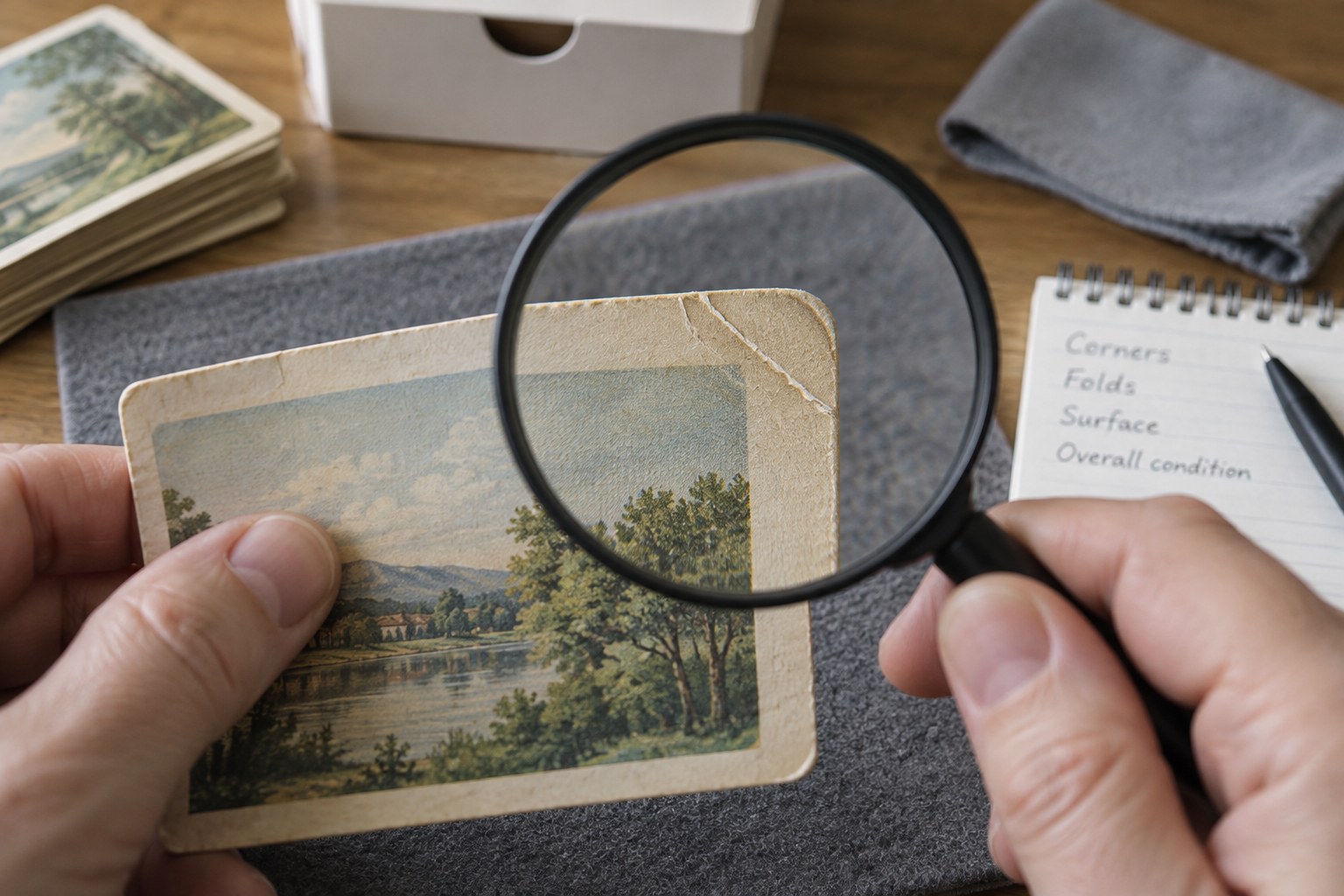
Follow the outline on a supported surface
Place the object on a clean support large enough for its complete footprint. Examine each corner and edge in turn, keeping your sequence consistent so none is missed. Look for missing portions, bent tips, tears and layers that appear separated. Describe location and extent rather than compressing everything into a general condition adjective.
Use a light direction that makes the outline visible and change the light rather than repeatedly lifting the paper. A darker background may help reveal a pale edge, while another background may suit a dark object. Keep the original safely supported throughout. Do not press a curled corner flat to make it easier to photograph.
Photograph the complete object and close views of relevant areas. A close-up without a full view can make a small defect appear disproportionately large or impossible to locate. Include enough neighbouring design or text to identify the position, and retain an unedited file for later comparison.
Describe folds without testing their strength
Record where a fold runs and whether it crosses printing, handwriting or an attachment. A visible line may be a crease, a former fold or another surface feature; if you cannot establish the cause, describe the line. Do not repeatedly open and close it to decide how flexible it remains. That test can become a new source of damage.
If the object is already folded and resists opening, document its accessible state. Ask a paper conservator how to proceed when safe access matters. Do not use household heat, steam or pressure to obtain a flat photograph. A partial record with a stated limitation is more useful than a complete image obtained by changing the object.
For a listing or inventory, distinguish missing paper from a folded portion that may still be present. Avoid claims such as easily repaired or only cosmetic when you have not established what treatment involves. Show the affected areas and explain which parts were not examined. That gives another person enough information to ask a focused question while preserving the original for further assessment.


