Making a component list for an older game
An older game is easier to assess with a component list tied to its exact edition. Counting a pile of pieces is only the beginning; identity and grouping matter too.
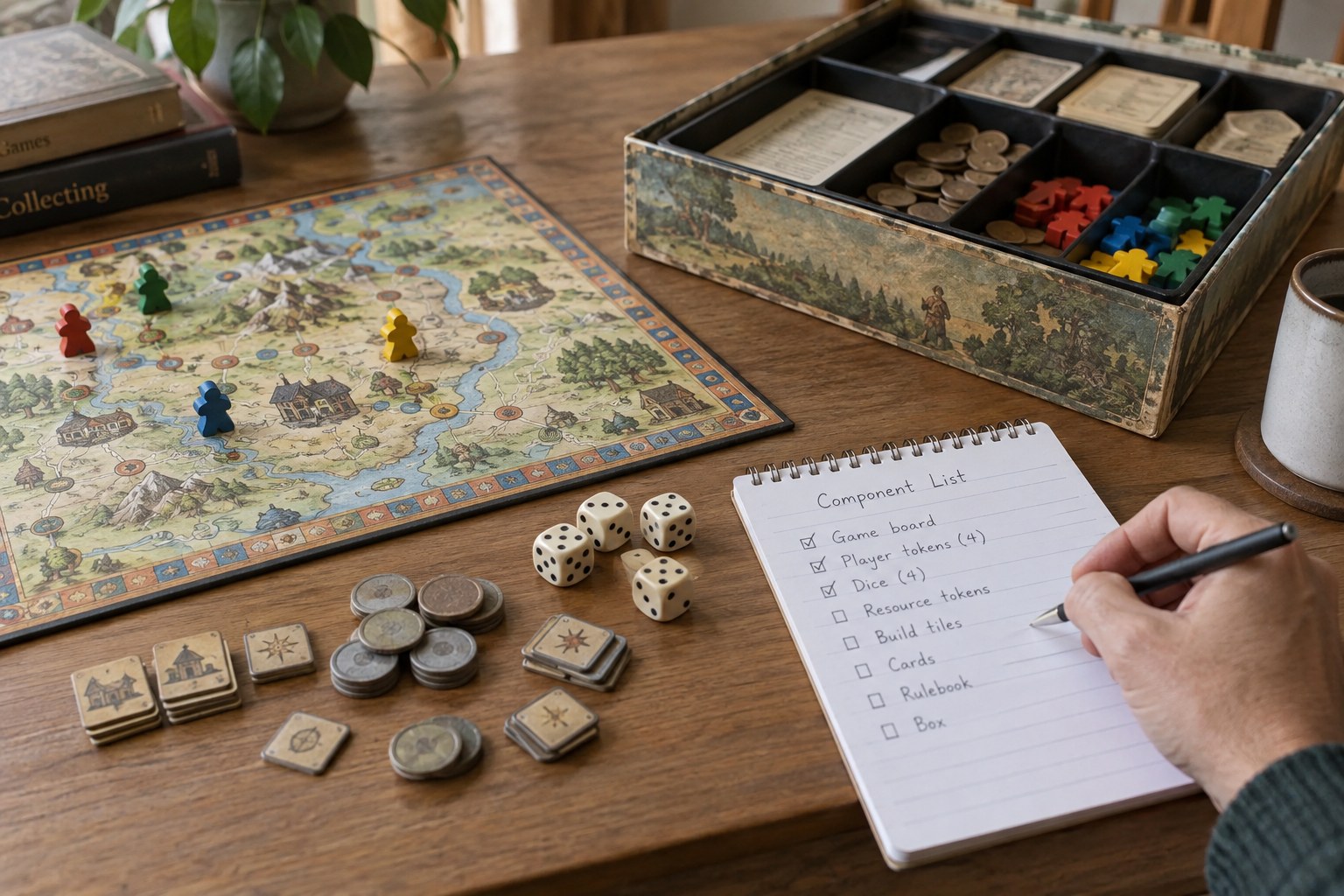
Find the right reference
Start with the title, publisher, language, edition and product reference printed on the box or instructions. Games with the same title can have different components across releases. Look for an original contents list or a publisher's manual matching those details. If the reference is from another edition, label it as a comparison rather than the definitive checklist.
Record which documents you have actually seen. A seller's assertion that the game is complete should remain a seller statement until it has been checked against a suitable list. If no reliable list is available, describe the observed contents without claiming completeness. That can still be a useful catalogue record.
Sort by function before counting
Work on a clear surface and keep small parts in shallow, separate groups. Divide boards, cards, tokens, dice, player pieces, money and instructions according to the game. Count each group and then examine its subtypes. A total of forty tokens does not establish completeness if the game requires particular colours or values within that total.
For card decks, record the number and any visible numbering or categories. Check for duplicates that may conceal a missing card. Do not assume a sealed or tightly wrapped group contains the expected sequence if you have not inspected it. Record the wrapper and the limit of what can be confirmed without opening it.
Separate missing, damaged and substituted pieces
Use different status fields for absent pieces, present but damaged pieces and possible replacements. A homemade counter can make a game playable while still differing from its documented contents. Describe it without dismissing its usefulness or presenting it as original. Keep uncertain pieces in the list with photographs and a note about why the association is unclear.
Inspect the box inserts and rulebook as components too. A game may contain all playing pieces but lack a divider, score pad or instruction supplement that matters to your collection. Decide which completeness claim you are making: playable with the listed contents, matching the documented component list, or including all known packaging. These are not interchangeable descriptions.
Make the list useful during a transfer
Assign each group a reference and photograph it laid out clearly. Include the count in the filename or accompanying inventory, but avoid numbering the collectible pieces themselves with ink or adhesive labels. Store the groups so the arrangement can be checked again without mixing everything into one compartment.
Before selling or lending the game, date the list and state any exclusions. After packing, compare each group with the record and confirm that the rulebook and loose inserts have not been left on the table. Give the recipient a copy of the list and keep one yourself. An accurate component record is more informative than an unsupported complete label, even when several gaps remain.