Organising family photographs as a collection
Family photographs can be organised without turning uncertain memories into facts. Preserve the old grouping, identify what you can and leave room for later contributions.
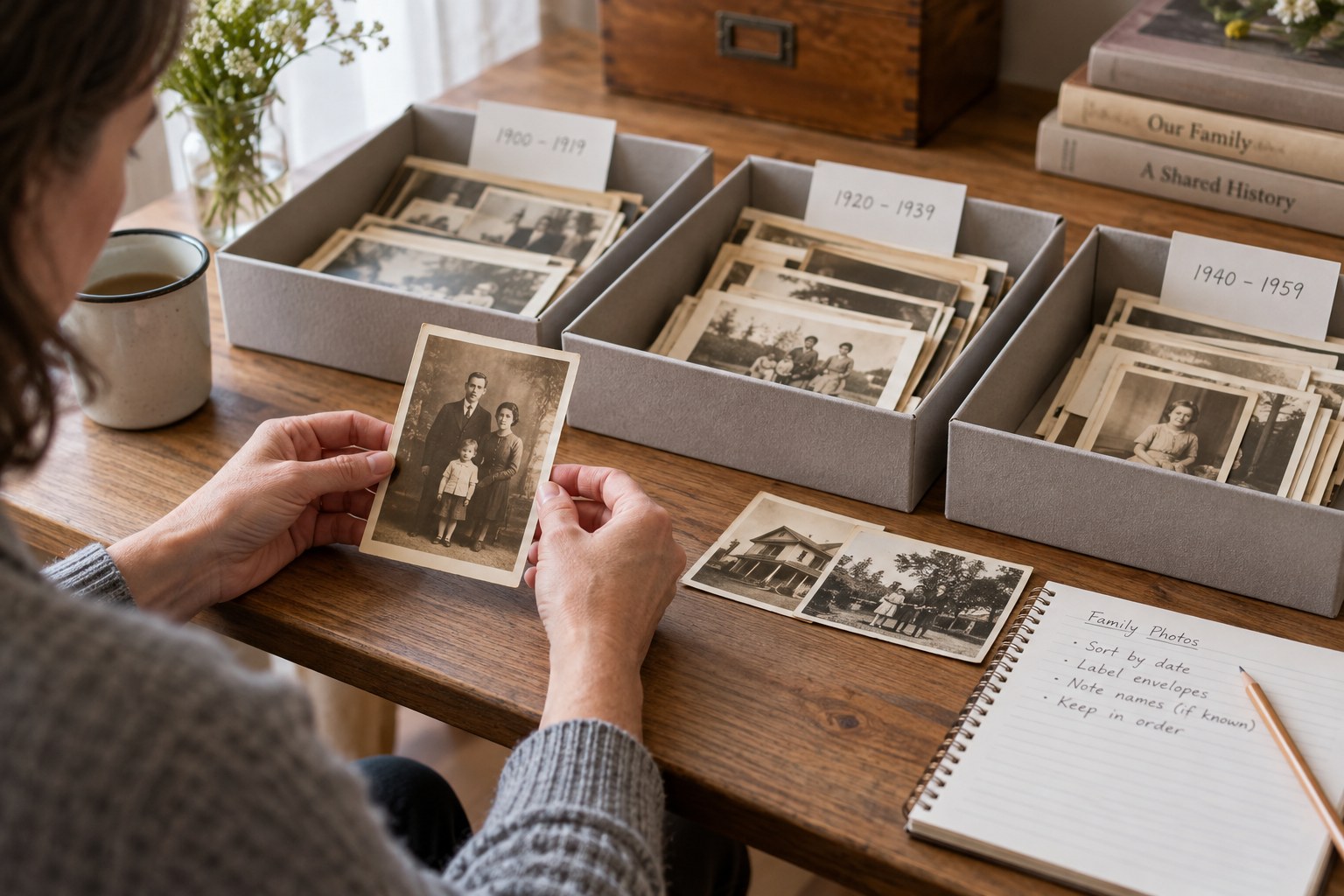
Capture the arrangement before sorting
Photograph boxes, envelopes and album pages as found. Number each group and copy any labels. A packet from one event may contain useful relationships even when individual faces are unidentified. Do not immediately rearrange everything by size or apparent date. First record enough context to reconstruct the former grouping.
Separate physical storage needs from the story you are documenting. Different formats may need different protection, but their records can remain linked. The Library of Congress notes that identifying photographic materials is important when choosing care and storage. If you do not know what a photograph is made from, record the uncertainty and seek suitable advice rather than assuming every old image behaves like a modern print.
Collect names with attribution
Ask relatives to identify people on a copy or digital image, keeping the original supported and protected. Record who supplied each name and when. Use positions such as back row, second from left to make the identification unambiguous. A surname shared by several people needs more detail than a single word written beside the image.
Keep disagreements visible. If two relatives identify the same person differently, record both accounts and their sources. Do not choose the more confident voice merely to finish the field. A later dated photograph or document may resolve the question. Until then, an explicit uncertainty is part of the record, not a flaw to conceal.
Separate dates and interpretations
Record a date written on the back as an inscription, then note who is believed to have written it if known. Clothing, vehicles and buildings may provide research clues, but a broad visual estimate should not become an exact year. Use date ranges where appropriate and explain their basis. Keep the event date distinct from a later printing or copying date when that distinction is known.
Transcribe back inscriptions before moving photographs into enclosures that make frequent access less convenient. Preserve spelling and uncertain words. Add a modern explanatory note separately rather than rewriting the inscription as though the extra information had always been present.
Create a reference set for sharing
Give each photograph a stable ID and use it in filenames, captions and housing labels. Capture both sides when the reverse carries information. Keep master images separate from presentation copies and review any automatic face or text labels before accepting them. Software suggestions can assist sorting without becoming verified identifications.
Prepare a sharing set that includes only the photographs and details appropriate to the intended family discussion. Keep private contact information and unrelated correspondence out of the export. Invite corrections using the photograph IDs, so a comment about one image cannot accidentally be attached to another similar pose.
Leave an understandable archive
Store the original photographs in appropriate enclosures with a location index, and back up the digital files separately. Keep a short explanation of the numbering, uncertainty conventions and source notes. Update the master record when new information arrives, preserving earlier interpretations where they explain older captions. A family collection remains useful when someone else can distinguish what was remembered, what was documented and what is still unknown.


