Organising models by scale on shelves
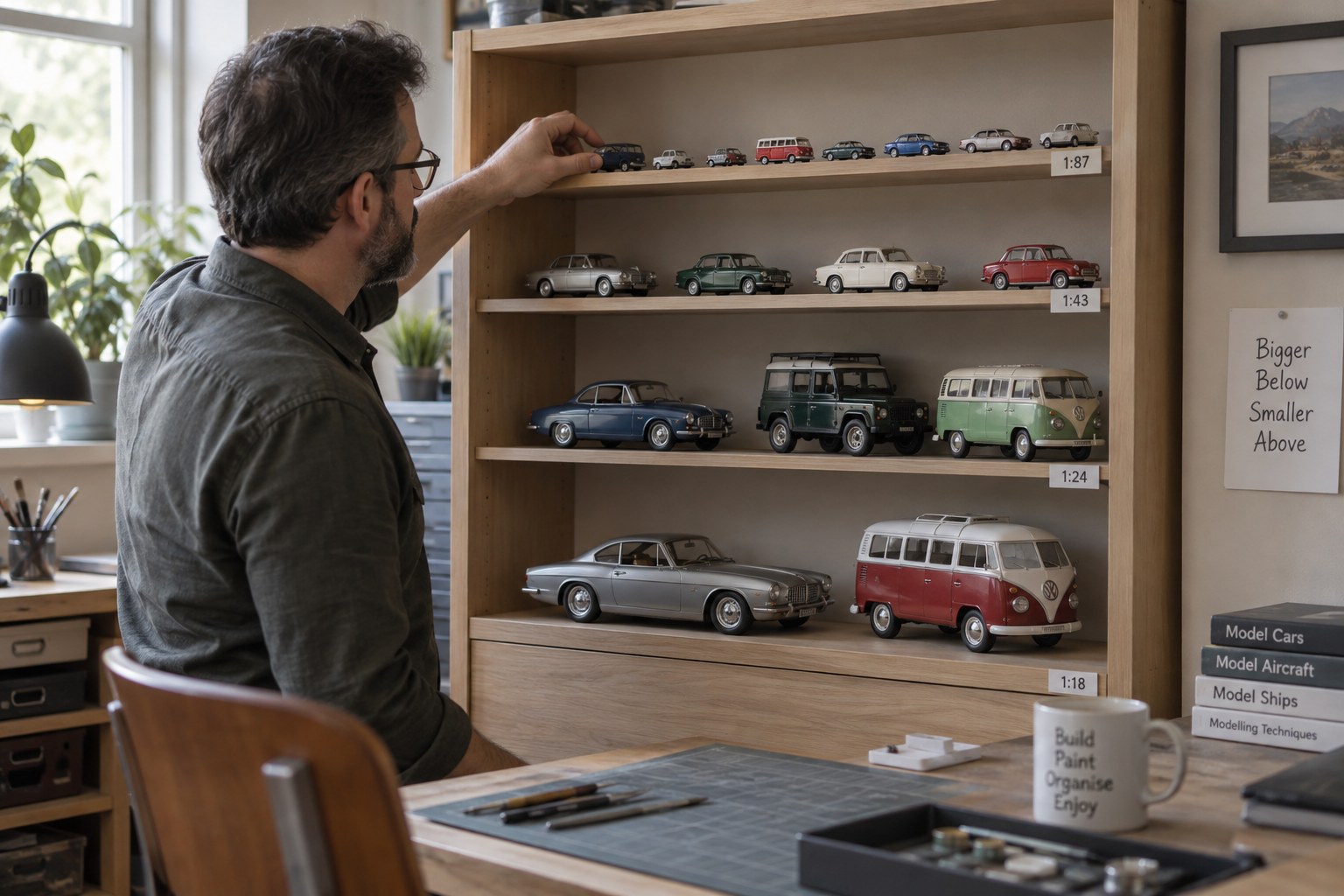
Grouping models by scale can make proportions easier to compare, but shelves also have physical limits. Plan the arrangement using actual footprints, heights and handling space.
Choose what the grouping should explain
Decide whether the display compares versions of the same subject, different subjects at one scale or the changing size of a model across scales. Those are distinct stories. A row labelled only small to large may hide the fact that a large real vehicle can produce a large miniature even at a relatively small scale.
Keep scale labels accurate and separate from measured size. If the scale is uncertain, use an approximate or unconfirmed note instead of placing the model among precise examples without explanation. A visually similar size does not establish a matching ratio, particularly for toys with simplified proportions.
Draw the shelf before filling it
Measure the shelf's usable width, depth and height, then draw the footprints of models and their bases. Include the space needed to remove a case or lift a model by a robust part. A layout that works only when objects touch each other will be difficult to maintain. Projecting mirrors, wings and aerials need clear surrounding space.
Check the furniture's load information and installation instructions. Do not distribute heavy bases according to appearance alone. If you cannot verify a shelf's suitability, use a different location or obtain advice before filling it. Keep the heaviest or most awkward pieces where they can be handled without reaching overhead.
Make labels useful without adding clutter
A small label can identify subject, maker and stated scale, with the inventory number discreetly included. Put detailed history in the catalogue rather than trying to print it all on the shelf. Use a consistent orientation so viewers can connect each label with its model without touching the objects.
If several scales share a shelf, create clear groups with space between them. Avoid raising a small model on an improvised unstable object solely to align it with a larger one. Any riser needs its own assessment for stability, surface compatibility and access. A simpler arrangement is preferable to a crowded display that relies on precarious height changes.
Leave room to rotate
Reserve a place for a temporary addition or rotate models instead of continually tightening the spacing. Record display locations so a model moved from storage remains easy to find. Photograph the arrangement after changes; this provides a useful reference when cleaning the surrounding furniture without handling the collection unnecessarily.
Review sightlines from your normal viewing position and from the height of someone seated. A model hidden behind a taller neighbour may be better on another shelf. Scale order should help people understand and enjoy the collection, not prevent them from seeing its individual pieces.