Recording clear and incomplete postmarks
An incomplete postmark is still evidence. Preserve the characters you can see and the position of the mark before deciding what place or date it represents.
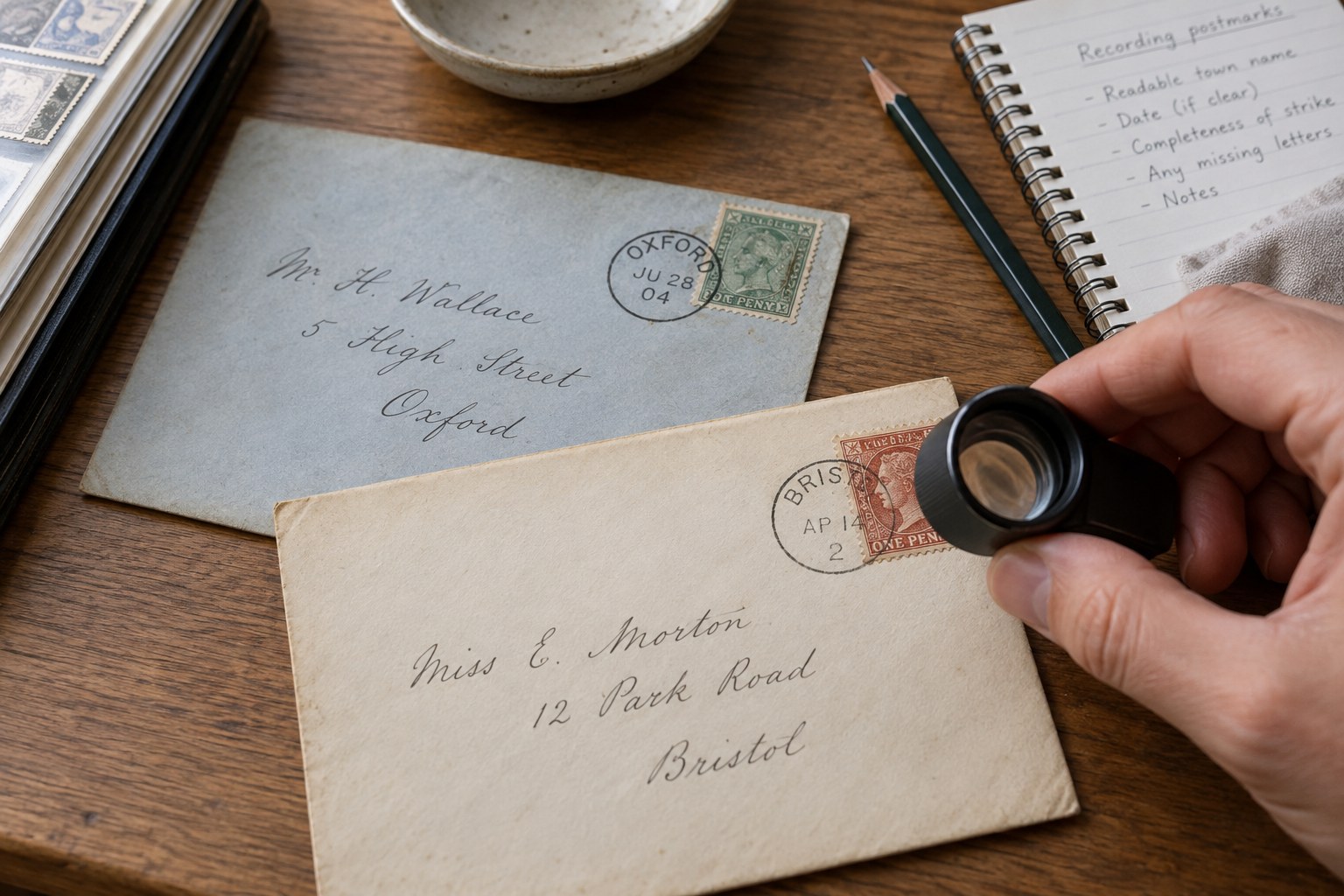
Make a literal transcription
Start by copying visible letters and numbers in their observed order. Use a clear convention for unreadable characters and explain it in the inventory. A missing letter is different from a letter you can see but cannot confidently identify. Do not complete a familiar town name automatically; several places may share the same beginning or ending.
Keep the transcription separate from your interpretation. One field can contain the visible text and another the proposed place or date. Add a confidence or research-status note rather than forcing every entry into a completed result. This allows searches for a place while preserving the original evidence for later checking.
Preserve the position and context
Photograph the complete stamp, postcard or cover, then add close views of the mark. A postmark crossing from a stamp onto an envelope should be recorded as part of that complete object. An isolated crop may omit the very letters needed to interpret it. Keep enough surrounding detail to identify the orientation and the relationship to other markings.
If several marks overlap, number them on an annotated copy and describe each separately. Retain the unmarked image as well. Avoid treating a handwritten date, a printed publisher’s number and a postal marking as equivalent evidence. A record should explain which feature supports each date or location you enter.
Test a proposed reading
Compare the proposed reading with the whole object. Does the visible sequence support the town name? Is the proposed date compatible with what you actually read, rather than merely with the design of the stamp? Compatibility can support an investigation, but it does not fill a missing character. Record the evidence for the proposal and the detail that remains unresolved.
Use appropriate postal references or institutional collections when researching a mark, and save the exact reference. A similar image found online can be a lead without being a confirmed match. Check whether the reference concerns the same form of marking and whether its caption distinguishes observation from attribution. Do not copy a confident caption onto your item just because the circle or lettering looks similar.
Document changes to the reading
If a clearer photograph or new reference changes your interpretation, date the correction and retain the previous reading in a note. This matters when older filenames, purchase descriptions or exhibition labels contain the earlier version. Renaming every file without recording the change can make the research trail harder to follow.
For example, an initial record might read a partial place name ending in TON and a proposed year with one uncertain digit. Later evidence may resolve the year but leave the place unknown. Update only the resolved part. Research rarely advances in a single all-or-nothing step, and the inventory should reflect that.
Share the uncertainty clearly
In a sale or exchange description, show the marking and distinguish a readable date from an interpreted one. Avoid presenting an uncertain destination, route or rare usage as established history. A buyer may value the object for its design or correspondence even when the postmark remains incomplete. Giving the actual evidence makes further discussion possible without promising a conclusion the object does not yet support.


