Storing banknotes without folding them
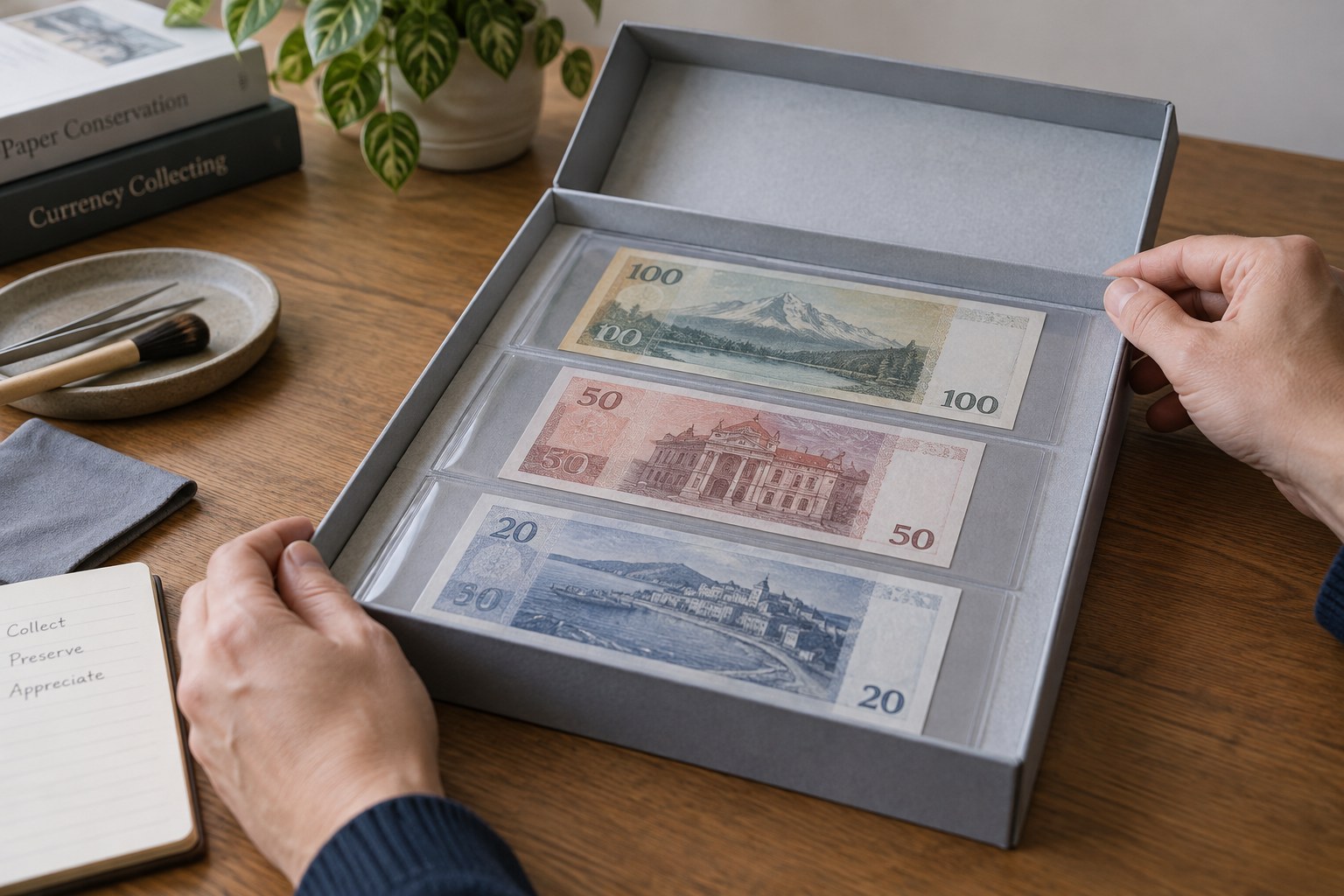
Flat storage is an arrangement that supports a banknote in its existing condition. It is not an instruction to iron, press or unfold a resistant piece.
Separate storage from treatment
Look at the note before choosing a container. Is it flat, loosely folded, sharply creased, torn or attached to something else? Those conditions call for different handling decisions. A flat, robust example may be straightforward to place in a suitable enclosure; a brittle note that resists opening should not be forced merely because the new album expects a rectangle.
Record the existing folds and photograph both accessible sides. If opening it would strain the paper, photograph the folded state and ask for conservation advice. Do not use heat, moisture or a pile of books as an improvised way to obtain a neater result. The immediate storage question is how to support what you have without adding another fold.
Plan the footprint and the route
Choose an enclosure with enough usable space for the complete note and any appropriate support. Then choose a box or drawer that accommodates the enclosure without bending it. Reversing that order can lead to buying a small box and forcing every object to fit. Account for retrieval: there must be room to lift the enclosure without pinching the note inside.
For several formats, group by storage needs while retaining links in the inventory. A large banknote need not be folded to remain physically beside a small one from the same country. Give the oversized group a separate location code and record that code in the country list. Intellectual order and physical order can differ without losing the collection’s story.
Prevent new pressure points
Avoid overfilling an album or box until the lid presses on the contents. Keep unrelated objects, receipts with staples and loose clips out of the same enclosure. Review what happens when the container is moved: a neatly arranged stack should not become a sliding pile that catches corners. Dividers or supports should fit the storage system without pressing directly into the banknotes.
Use labels on the housing rather than adding marks to the note. Keep a simple map of the storage order, especially when some pieces require larger enclosures. After a few weeks, check that ordinary access has not introduced bending or edge pressure. If the arrangement is awkward each time you retrieve a piece, change the arrangement instead of accepting repeated strain as part of collecting.