Storing complete covers without trimming
A complete cover connects stamps, addresses, markings and the envelope itself. Keep those elements together while choosing storage around the object’s full dimensions.
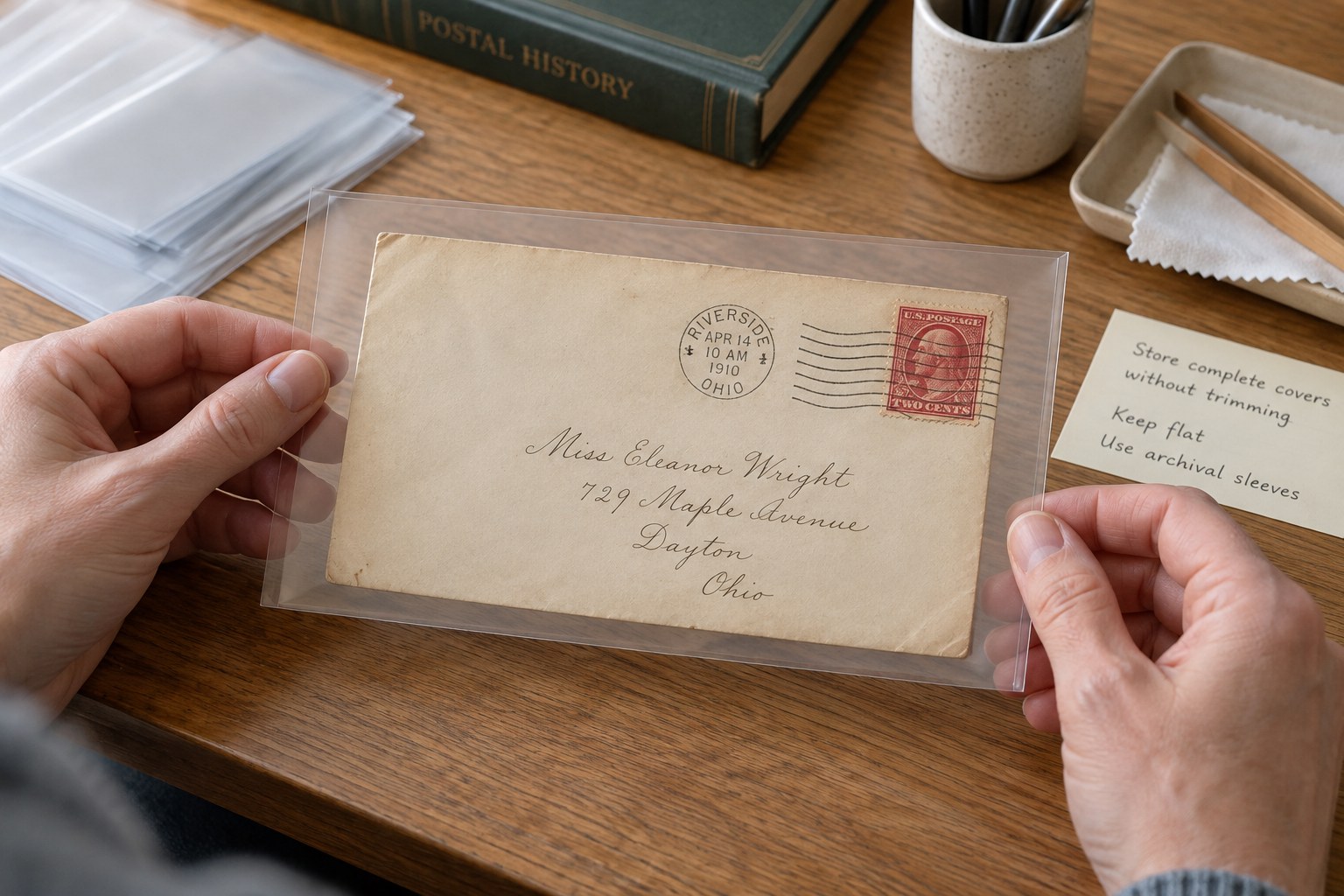
Record the complete postal object
Photograph the front and back before changing the arrangement. Include all edges, flaps and any visible contents without forcing sealed or fragile parts open. Give the cover a single inventory record and describe its components within that record. A stamp, cancellation and address may explain one another in ways that are lost when each is treated as a separate collectible.
Copy readable dates and places, but distinguish the address from the origin suggested by a postal marking. Those locations need not be the same. Record uncertain readings explicitly and keep a close image with enough surrounding context to locate the mark. Do not crop the master image so tightly that the route or relationship between markings becomes difficult to reconstruct.
Fit the enclosure to the existing form
Measure the full width and height, including projecting flaps or attached material that must remain. If the envelope contains documents, consider the thickness as well as the footprint. A sleeve that fits an empty postcard may not fit a filled cover. Ask for usable internal dimensions and materials appropriate to the paper and any other components.
Do not trim an edge, remove a flap or cut out a stamp to make the cover fit a standard page. Choose a larger enclosure or a separate storage location and link it in the index. If a cover is distorted or brittle, support it in its existing condition and ask for conservation advice before trying to flatten it.
Keep contents and associations traceable
Where loose contents can be accessed safely, record how they were arranged and assign linked component references. A letter may need a separate suitable enclosure while remaining intellectually part of the cover. Note the relationship in both records. Avoid assuming every loose sheet found nearby originally belonged inside; describe an uncertain association as uncertain.
For browsing, use a photograph or reference copy when that avoids repeated handling of a fragile original. Keep private personal information in mind when sharing images of correspondence, and select only the material needed for the collecting discussion. A storage label can identify the object without reproducing a full personal address on the outside of the box.
When preparing a sale, say whether the envelope is empty or includes recorded contents, and show the complete item offered. A detailed stamp close-up can supplement the overall images but should not replace them. The object’s intact form is part of what another collector needs to assess.


