Storing detached accessories without losing them
A loose accessory can lose its identity long before it is physically lost. Link small parts to their model at the moment you separate them.
Give the parts a parent record
Use the model's inventory number as the starting point and add a simple suffix for each accessory or group. Photograph the pieces beside the model without forcing them into place. Record quantity, colour, approximate dimensions and any visible marking. If you are unsure whether a piece belongs to the model, record it as an uncertain association rather than attaching it to the history as fact.
Write where each part normally fits or how it was supplied. A loose display stand, alternate hand and miniature tool can look anonymous once separated from their packaging. A small reference image in the catalogue often answers the question more reliably than a descriptive name alone.
Choose a container that preserves the grouping
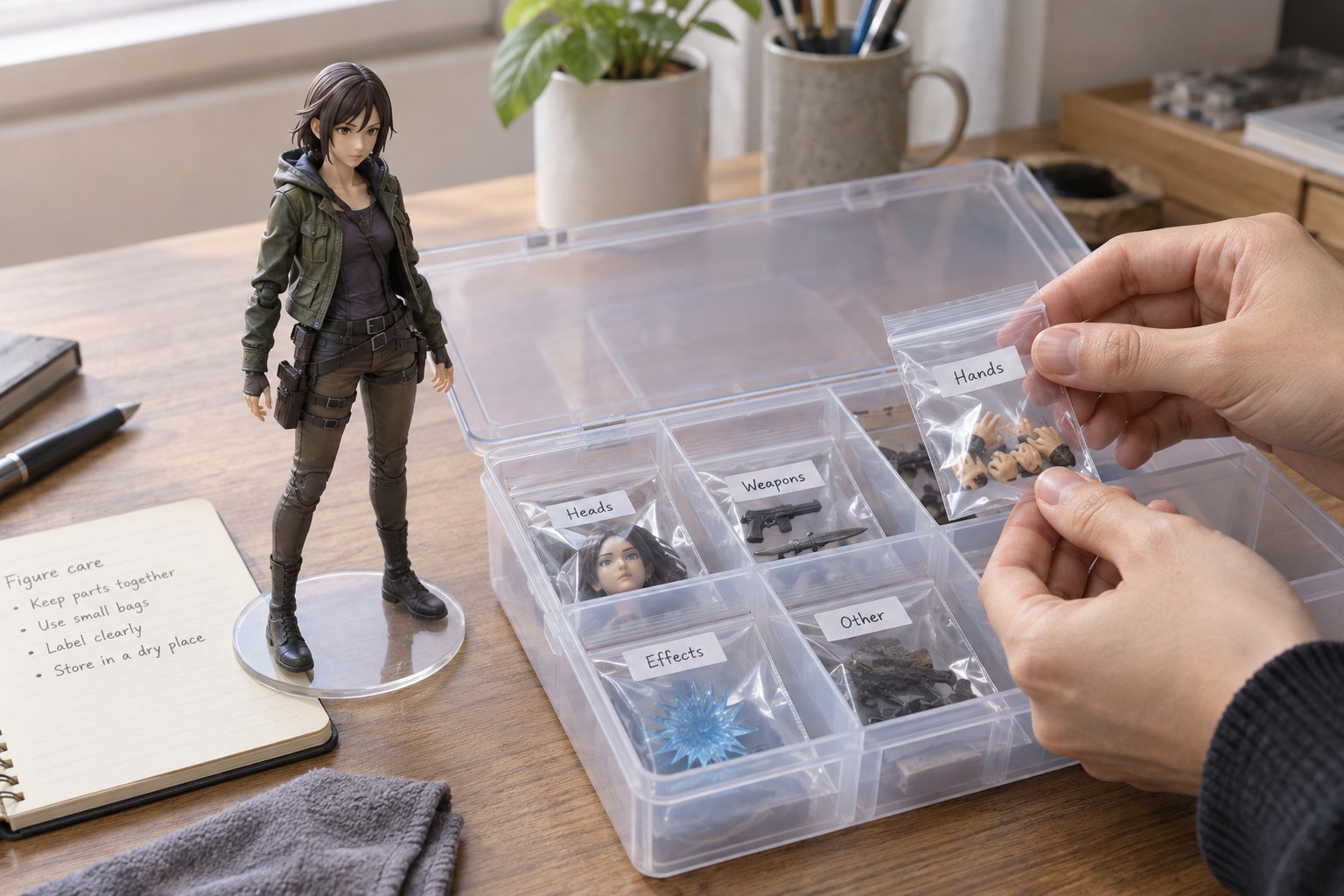
Use a suitable small enclosure or compartment that prevents pieces from rubbing against one another. Check that projecting details are not pressed by the lid. Label the enclosure externally with the parent number and contents; do not stick labels onto the accessories themselves. Avoid combining several models' parts in an unlabelled bag simply because the pieces are similar.
Store the accessory container in a recorded location close to, or clearly linked with, the model's main storage. If the model is displayed elsewhere, keep the accessory location in the same record. A note saying accessories in drawer is less useful than a drawer number and a labelled compartment.
Keep original inserts or packets when they form part of the collection, but do not assume damaged packaging remains suitable for holding loose parts. Record the original packaging separately if you need a new protective enclosure. This preserves the relationship without forcing a fragile component back into a failing pocket.
Count during every transfer
Before moving, selling or lending the model, compare the accessory group with the photograph and count. Check the empty enclosure after removal so a small piece does not remain behind. Update the location when anything moves, even temporarily.
If a part goes missing, keep its record and mark its status. Deleting the entry makes the model look complete by removing the evidence of what should be present. A visible missing-part note is more useful for future searches and for an accurate description of the collection.