Storing game boards and components separately
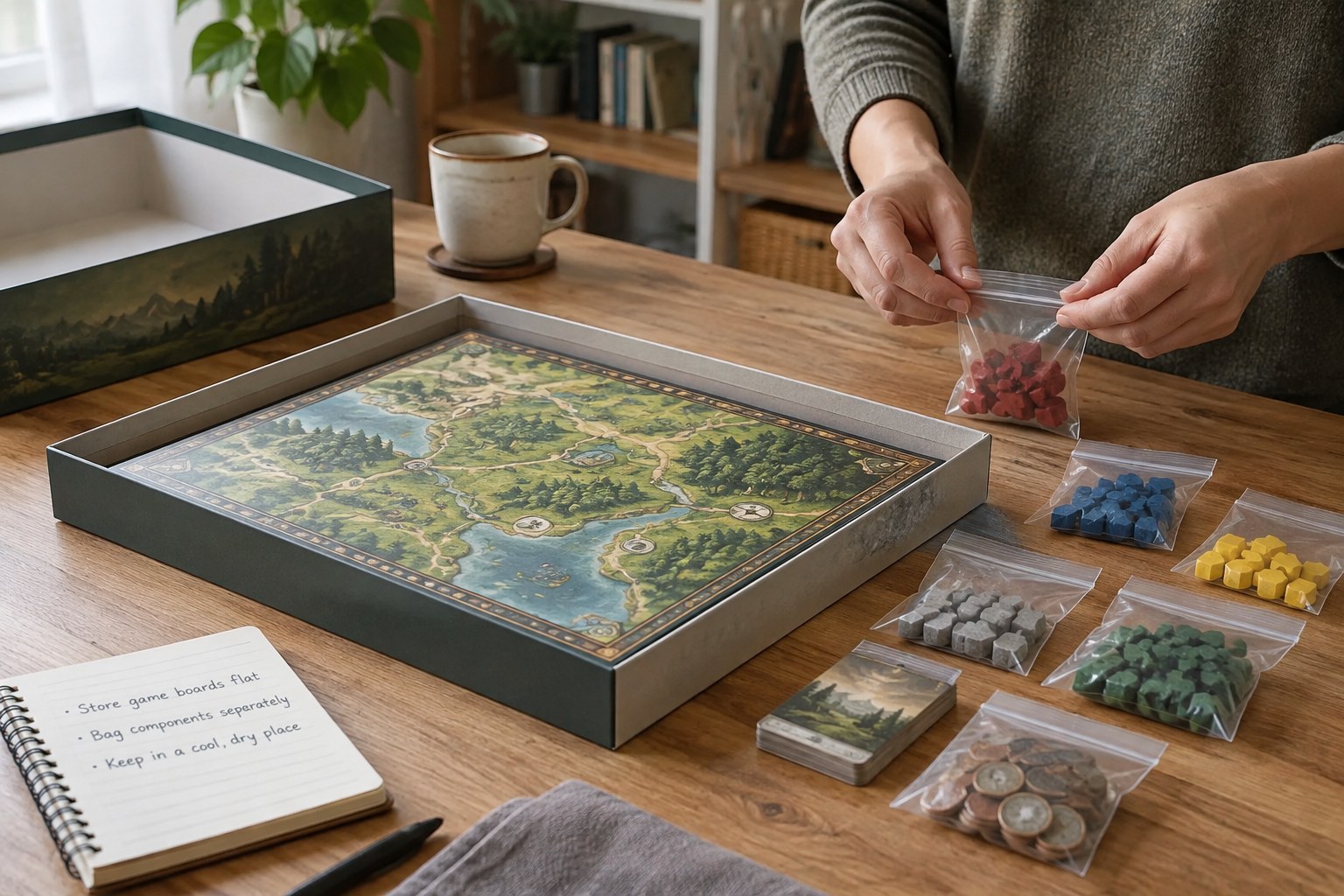
Separating a board from its playing pieces can reduce crowding inside an old box. The arrangement works only if every component remains clearly linked to the same game.
Understand why the original arrangement no longer works
Photograph the complete contents and how they are currently packed before changing anything. Look for pieces pressing into the board, a lid that will not close naturally, or loose counters moving against printed surfaces. Note whether the problem comes from added accessories, damaged inserts or a box that no longer supports its contents. Do not force the lid down to preserve an attractive original arrangement.
Keep the original packaging and inserts identified as components of the game when they belong to the collection. Rehousing the board does not mean the old box has become disposable. Record its condition and its new location, especially if it carries edition information that is not repeated on the playing pieces.
Create linked storage locations
Give the game a parent inventory number and use related labels for the board, pieces, cards and documents. Label their enclosures externally. Write all locations in the parent record so finding the board leads directly to the other components. A note that says stored separately is incomplete without saying where.
Choose support appropriate to the board's dimensions and condition. Do not make an extra fold merely to fit a smaller container, and do not flatten a reluctant hinge by pressure. If the existing fold is fragile, record that condition and obtain conservation advice about support rather than repeatedly opening it to test the limit.
Keep small components organised
Separate pieces into clearly identified groups so they cannot scratch or press on one another. Count them against the component list before closing each enclosure. Cards and paper instructions should not share a loose compartment with heavy playing pieces. Check the materials and dimensions of any new storage rather than relying only on a label promising universal suitability.
Include a simple packing diagram or photograph in the catalogue. This is particularly useful when several trays or boxes belong to one game. It should show the relationship between containers without requiring you to handle every piece each time you check the inventory.
Reassemble only for a defined purpose
Before a game session, display or transfer, use the list to gather the required groups and count them. Keep the empty enclosures together so they are not mistaken for spare packaging. Afterward, return every group to its recorded location and note any missing or changed component.
If the collection is passed to someone else, supply the linked-location list with it. Separation should make the game easier to care for, not create a puzzle that only its current owner can solve.