Storing posters rolled or flat
Flat and rolled storage each require enough space and the right support. The decision begins with the poster’s current condition, not with the empty shelf available at home.
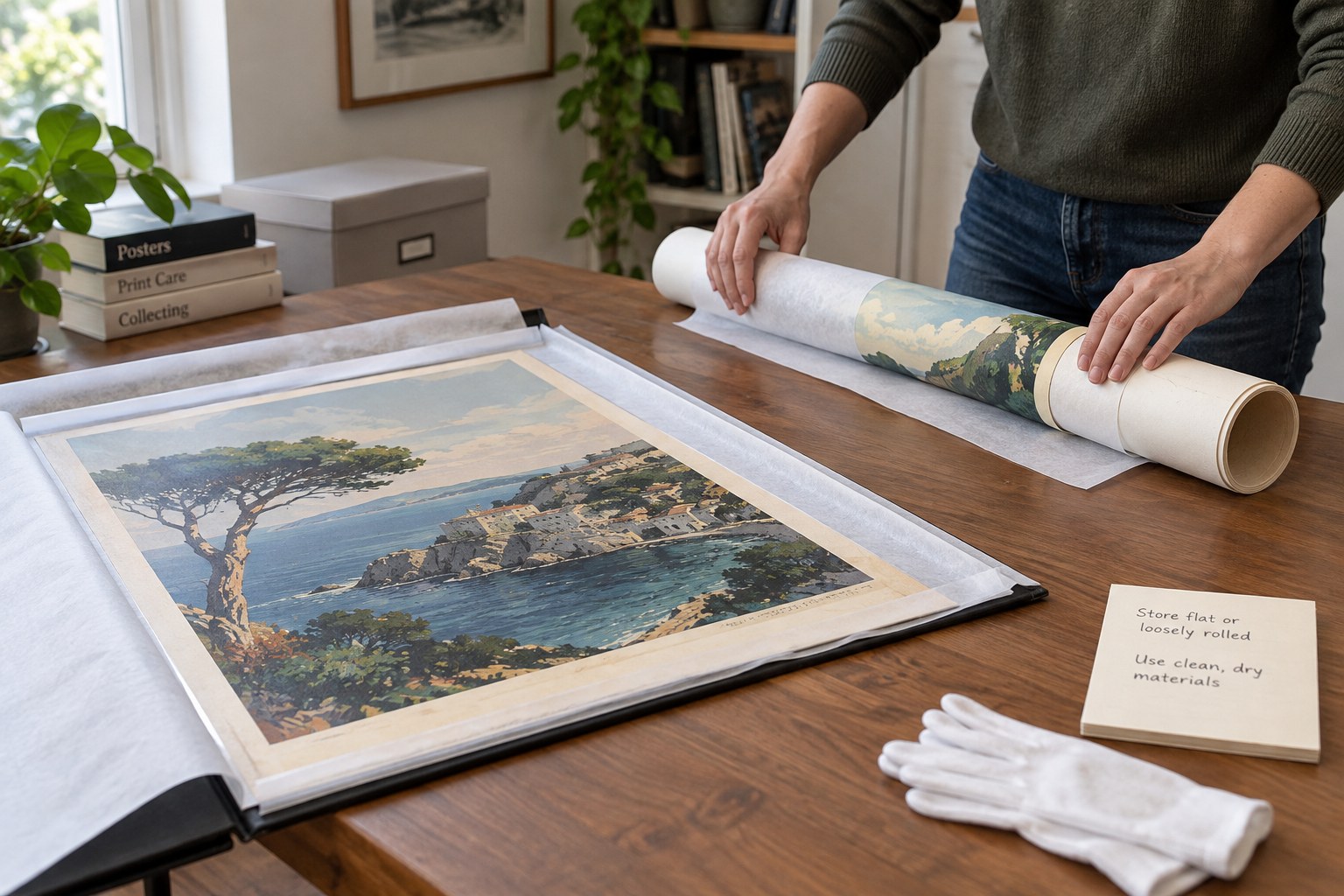
Inspect the existing form
Record whether the poster is already flat, rolled or folded, and note tears, brittle edges, attached material and areas that appear to be separating. Do not force it into another form to make the assessment easier. A poster that resists unrolling needs a different response from a robust sheet that already lies flat. Ask a paper conservator when changing the form could strain the object.
Measure the accessible dimensions without pulling against curls or folds. Include any backing or mount that must remain. Keep a photograph of the current arrangement and the information on existing packaging. A commercial shipping tube may explain how it arrived without being the storage system you should automatically retain.
Evaluate flat storage as a complete footprint
A flat arrangement needs support for the entire sheet and room to retrieve it without dragging its edges. Measure the filled folder or enclosure, not only the printed image. Check the drawer or shelf depth and the route from storage to viewing table. An object that fits only when pushed diagonally into a drawer does not have usable flat storage.
Avoid building a heavy stack that requires moving many sheets to reach the lowest one. Separate groups and identify them clearly. The appropriate folder and support materials depend on the poster’s construction; obtain specifications from a preservation supplier and explain any unusual coating, attachment or medium. Do not assume all posters are ordinary uncoated paper.
Ask specific questions about a rolled arrangement
If rolling is being considered for a suitable object, ask a conservator or preservation supplier about the support, enclosure and diameter appropriate to that poster. Do not improvise a tight roll around an arbitrary household tube. A fragile surface, existing damage or mixed construction may make rolling unsuitable even when it solves a space problem.
Consider how often you intend to consult the poster. Repeated rolling and unrolling may create a handling burden that a different storage or display plan avoids. A digital reference image can provide routine access while the original remains housed. Record the arrangement and any professional advice so another person does not later reverse it casually.
Make retrieval part of the decision
Whichever form is appropriate, give the enclosure a clear ID and location. Store it where it will not be crushed by unrelated objects or repeatedly moved to reach household items. Before adopting the system for a whole group, test retrieval with a harmless substitute of similar size. The aim is supported access, not merely finding a place where the poster disappears from view.


