When to use archival boxes for paper
A box can protect a paper collection only when its size, materials and internal arrangement suit the contents. Treat the box as part of a system, not a cure for every storage problem.
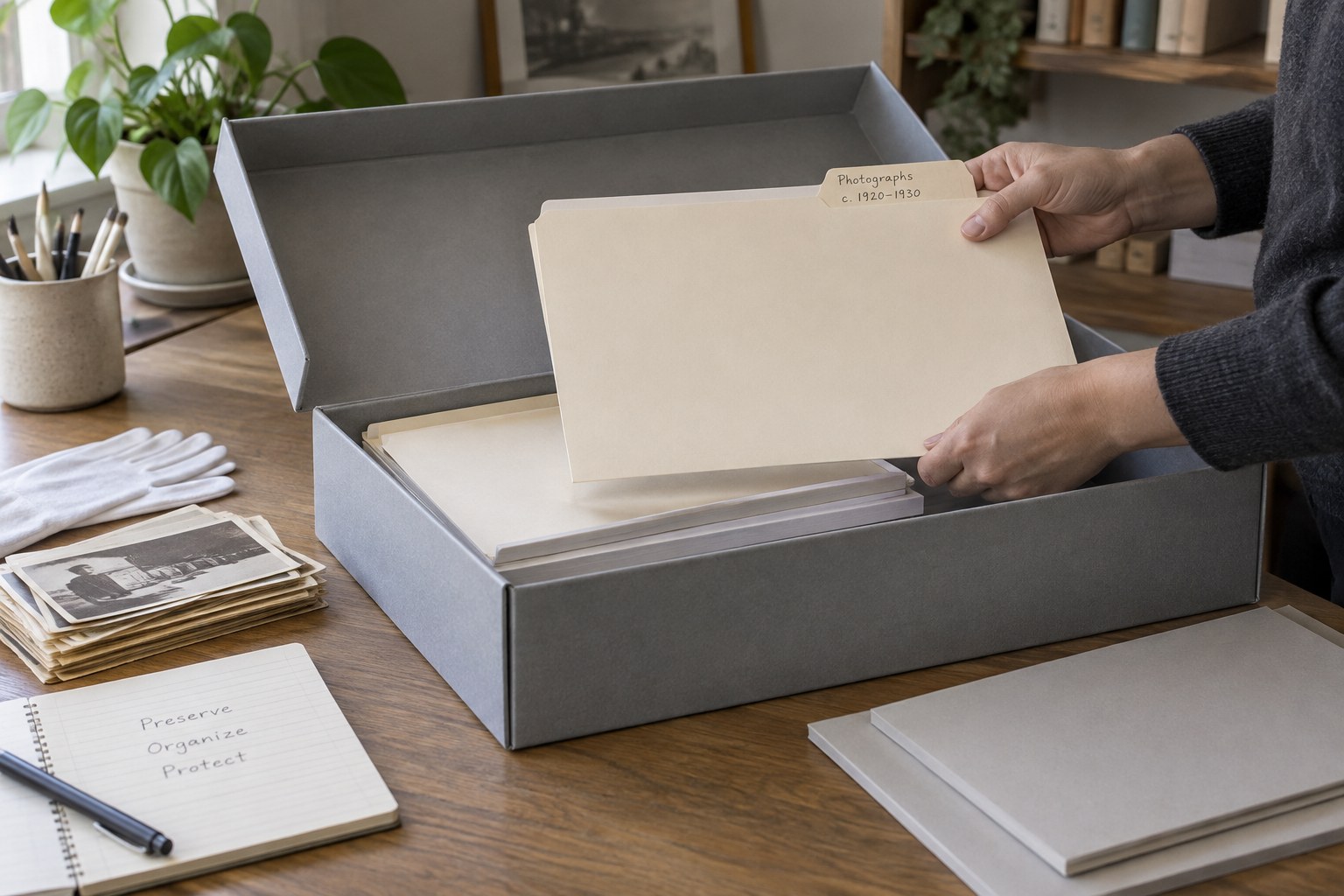
Choose the contents before the container
List the formats you plan to house and identify which need individual folders or sleeves. Measure the filled enclosures, including their thickness and any support. A box that fits bare sheets may be too small once they are protected. Keep fragile, oversized or differently constructed objects separate when they need another arrangement, and connect them through the inventory.
Ask for usable internal dimensions, construction and material specifications. The word archival on a listing is not a complete description of suitability. Tell the supplier whether you are storing ordinary paper documents, photographs or a mixed group, since the materials and requirements may differ. Keep the product information with your storage records.
Plan loading and retrieval
Choose a box you can lift comfortably when filled. Several shallow boxes may be easier to handle than one deep container packed with heavy paper. Check where your hands will go when lifting it from the shelf and whether the lid can open on your work surface. A container that fits the shelf but cannot be removed safely is not a successful fit.
Inside, arrange folders so they can be retrieved without dragging across delicate edges. Avoid cramming the box until every removal requires pressure. At the same time, do not leave unsupported material sliding through a large empty space whenever the box moves. Use suitable dividers or supports designed for the arrangement, without pressing them into the objects.
Make the closed box informative
Give the box a stable location code and a concise contents label. Keep a more detailed inventory outside the box or digitally so routine searches do not require opening every container. Date the contents list and update it when folders move. A label such as old papers may be true but is rarely sufficient to retrieve a particular group.
Store the box in a suitable indoor location and inspect it periodically for changes, damage or evidence of a leak. A protective container does not cancel the risks of an unsuitable environment. If the contents show a problem, record it and seek advice rather than sealing the box and assuming the enclosure has solved it. Good storage combines appropriate housing with a usable record and regular attention.


