Choosing comic boxes you can lift
A box can fit the shelf and still be awkward to move once filled. Choose comic storage around the complete lifting task, not just its advertised capacity.
Start with the journey to the shelf
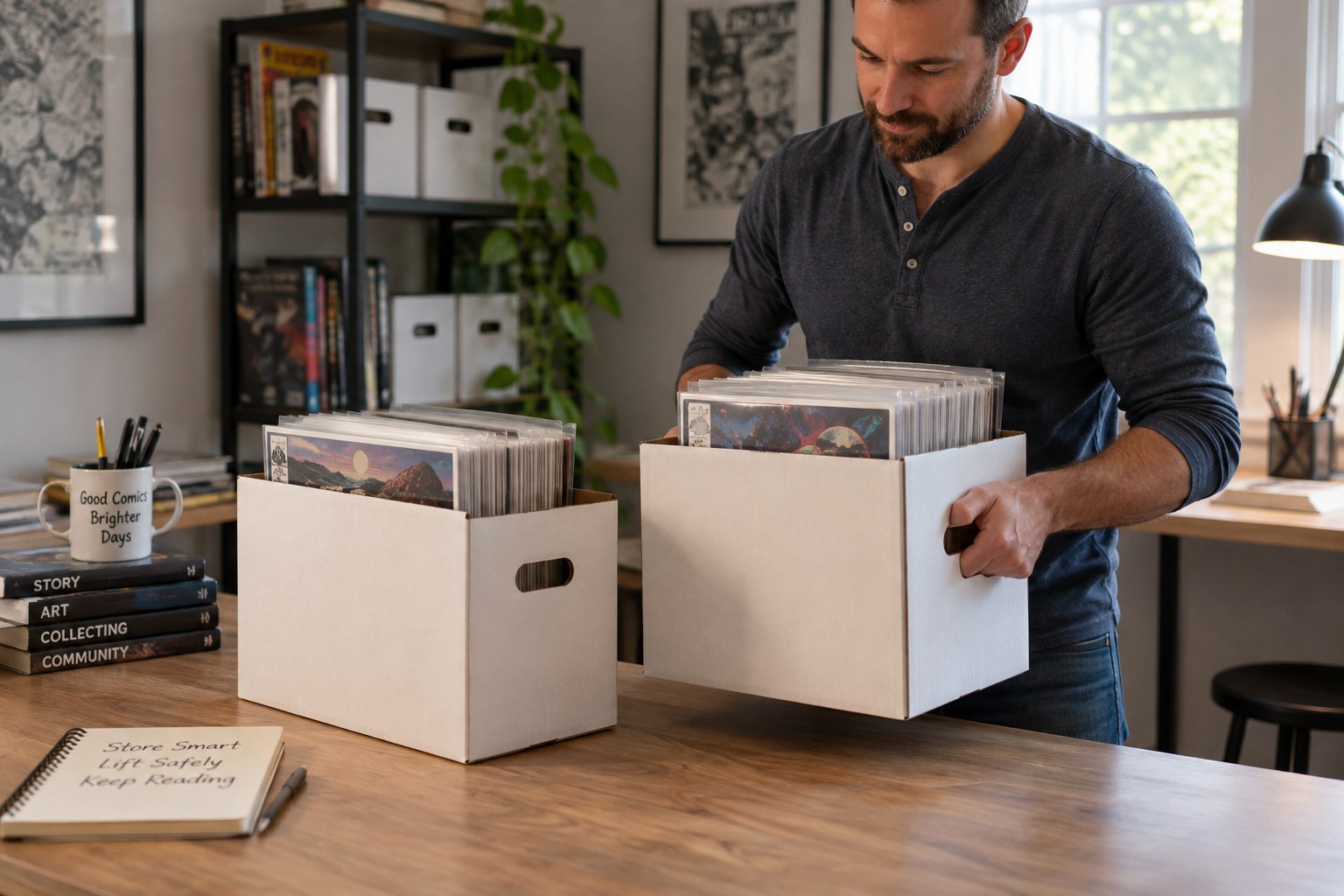
Imagine taking a full box from its normal location to the table where you read or sort comics. Include doors, corners and the space needed to turn around. A long box that passes through a doorway may still be difficult to carry while keeping it level. If you usually work alone, base the choice on what you can comfortably handle alone.
Check the shelf depth, usable height and the clearance above the lid. A box stored high overhead asks you to lift and lower its contents in an awkward position. Heavy storage belongs where it can be reached without climbing or stretching; follow the shelving manufacturer's load and installation instructions rather than estimating strength from appearance.
Capacity is a limit, not a target
A stated number of comics assumes a particular thickness and packing arrangement. Bags, backing boards and special editions change the result. Filling every available space may make both lifting and individual retrieval harder. Test the planned arrangement with a small group and look for room to separate the bags without bending covers.
Compare the empty weight of different box types as well as their dimensions. Inspect handles, folded corners and the way the bottom closes. A handle opening should allow a secure grip without placing your fingers against a comic. Ask whether the manufacturer gives a loaded-weight limit and whether it applies to carrying, stacking or both; these are different uses.
Do not perform a maximum-load experiment with your collection. If you need to compare sizes, use ordinary material of known weight in a sample box and stop well before the load becomes uncomfortable. This tests your access route and grip without putting comics inside an unproven container.
Divide the collection with retrieval in mind
Several shorter boxes can be easier to move than one long box, although they occupy more space in lids and walls. Divide by a system you actually use: series, publisher or a range of inventory numbers. Put a readable range label on the accessible end so you do not have to pull out several boxes to find one issue.
Leave a plan for growth. An empty gap inside a box needs appropriate support so comics do not slump, but filling it with unrelated purchases makes the catalogue harder to use. Review the arrangement when a run expands. Moving a few issues between labelled boxes is preferable to keeping an increasingly heavy container simply because its original label still looks tidy.