Describing a comic spine
A useful spine description tells the reader where a mark is and what it looks like. It does not require you to assign a numerical grade.
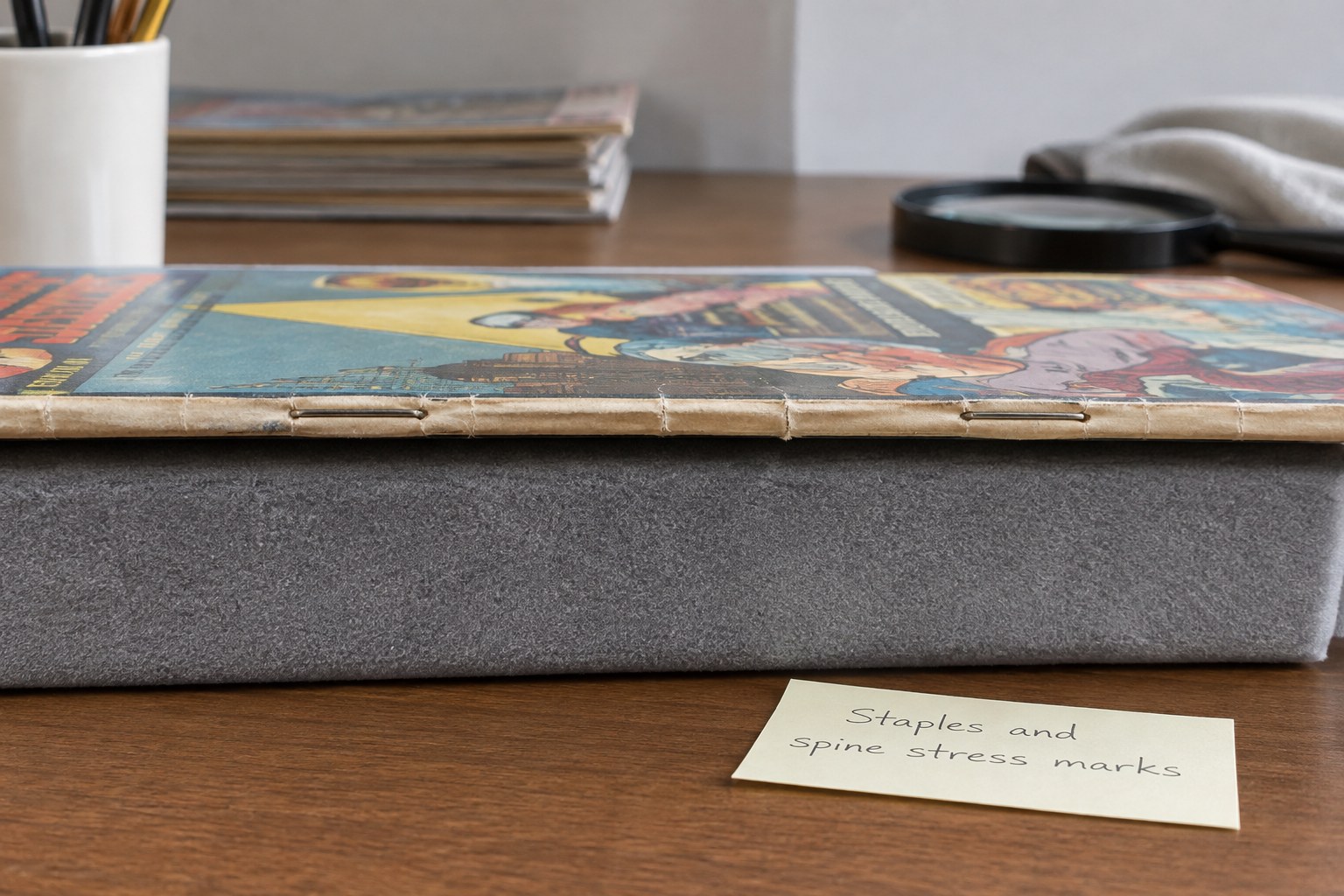
Follow the spine from top to bottom
Place the closed comic where you can see the fold without twisting the covers. Start at the upper end, then examine the middle and the lower end. Record short creases, rubbed areas, tears and any separation you can actually see. Use the same direction in your notes so a buyer can follow the description alongside the photographs.
Describe location and extent together. A short mark beside the upper staple communicates more than spine wear. Where measurement is useful, hold a ruler nearby without touching the paper. Do not turn an uncertain mark into a precise measurement if the photograph or viewing angle does not support it.
Separate observation from explanation
You may see a crease that changes the printed colour, a dark area around a staple, or a cover that sits unevenly. Record those visible features. Avoid stating why they happened unless you have reliable history. A photograph cannot establish every cause of discoloration, and a neatly aligned cover does not prove that a comic has never been repaired.
If a staple appears loose or the paper looks fragile, stop manipulating the comic to investigate. State that you have not opened it further. The purpose of a condition description is to communicate what you can inspect safely, not to produce a complete diagnosis by repeatedly moving a vulnerable part.
Keep repairs and uncertain features in separate notes. Tape visible along the fold can be described as visible tape, with its location, without guessing when it was applied. A suspected repair that you cannot confirm should remain a question, supported by a photograph, rather than becoming an accusation or an assurance.
Photograph the whole and the detail
Make one image showing the full spine and additional close views of the areas mentioned in the text. Keep the comic in a consistent orientation. A close-up without surrounding context can exaggerate a tiny mark or make it impossible to locate; an overall view alone may hide it.
Use light that reveals the surface without a harsh reflection. Retain a neutral overview as well as an angled detail where a crease becomes clearer. Do not edit away dust-like marks unless you know they were on the camera or background. Finish by checking that every significant observation in the description has a corresponding photograph, and that the images do not suggest a more complete inspection than you performed.