Comparing fixed-page and removable-page card binders
Fixed-page and removable-page binders solve different problems. The better choice depends on how often the collection changes, how you view it and where the filled binder will live.
Start with the way the collection grows
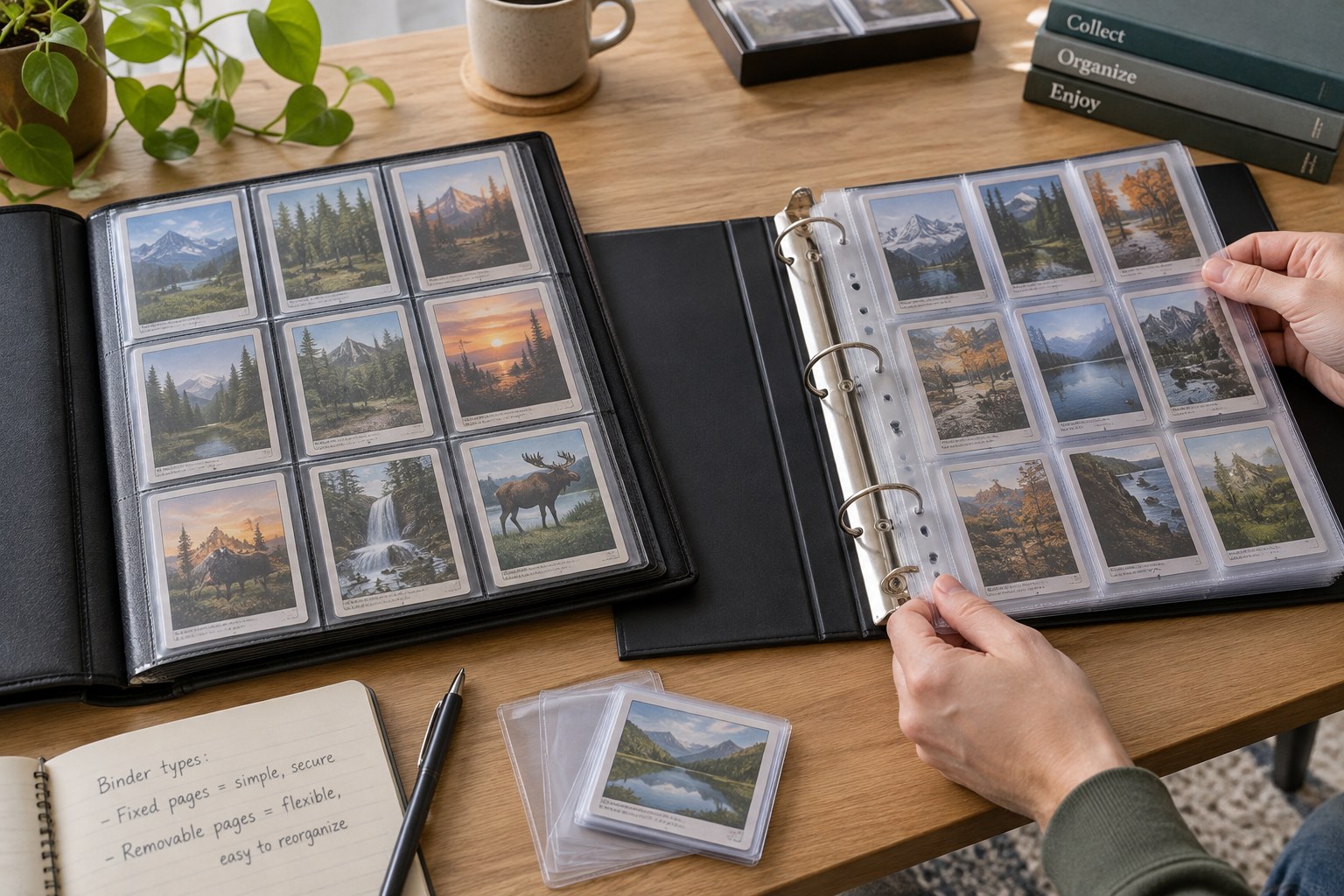
A fixed-page binder offers a defined sequence and capacity. It can suit a collection whose order is already settled, especially when you want to turn pages without opening a mechanism. The trade-off becomes apparent when a new group belongs in the middle: you may need to move many cards, leave planned gaps or change the organisation entirely.
Removable pages let you insert a new section or transfer a group to another binder. That flexibility is useful for a collection expanding unpredictably, but it adds decisions about compatible pages and the mechanism holding them. Before choosing, sketch the collection as it exists now and as you reasonably expect it to look after the next few additions. Do not buy for an imaginary complete collection if that arrangement makes today's small group difficult to use.
Examine the page and the opening
Count pockets and check their usable dimensions with the sleeves you intend to use. Front-loading, side-loading and top-loading layouts behave differently when a page is turned or a binder is carried. Inspect how much of the card is visible, how you would remove it and whether adjacent pockets interfere. A photograph of an empty page cannot show how a thick, sleeved card changes that arrangement.
Check whether the maker permits two cards back to back in a pocket. Do not assume that a clear pocket is intended for double loading. If you want to view both sides, putting another card behind the first defeats that purpose even when the pair physically fits. For a mixed collection, mark the few thicker or larger cards that need a separate solution.
Try the turning motion
Test an example binder on the surface where you will normally use it. Open it without forcing the cover flat, then turn a loaded sample page slowly. Look for pulling at the binding, pockets touching a hard mechanism and pages bunching near the centre. With removable pages, check that holes match the mechanism and that closed rings or fasteners align properly.
Consider the beginning and end of the binder as well as the middle. A page that turns easily when the binder is almost empty may behave differently when all positions are filled. Follow the maker's capacity instructions and leave room for pages to move. Extra capacity is not useful if the binder becomes so thick that you cannot close or carry it comfortably.
Compare replacement and storage costs
For a fixed-page design, damage to a single page may be harder to address without replacing the binder. For a removable design, replacement pages are useful only if you can obtain the correct size and hole pattern. Check the actual product range, not just a promise that standard pages will fit. Save references for both binder and pages with your storage notes.
Measure the filled binder's outer dimensions against the shelf, including any zip or projecting handle. Think about how you will remove it without pulling on the pages. If several binders will stand together, identify them on the visible spine and avoid packing them so tightly that retrieval becomes a struggle.
Choose with a small trial
Put a representative selection into one sample: ordinary cards, sleeved cards and any thickness exceptions. Use it for a real sorting session before ordering several matching binders. Record which inconveniences appeared. Moving cards to preserve order might be acceptable for a finished set but frustrating for an actively expanding collection.
There is no requirement to make every binder identical. A completed set can use a different system from frequently traded duplicates. Keep the catalogue's location field clear enough to connect both arrangements, and let the storage serve the collection rather than forcing the collection into one purchased format.