Inspecting card corners, edges and surface
A card inspection is more useful when the observations are organised by area. You can describe visible condition without turning the exercise into an unofficial grading service.
Begin with an overall view
Look at both sides under even light before concentrating on tiny details. Record the card's orientation and any obvious bend, stain, writing or missing area. If it is inside a holder, distinguish marks on the holder from marks you can actually locate on the card. Do not assume every line visible through plastic is a scratch in the printed surface.
Decide whether removal is appropriate before handling it further. A fragile card, an unfamiliar closure or a certified encapsulation may be better left undisturbed. An inspection through a holder has limits; describe them instead of presenting a complete condition assessment.
Work around the four corners
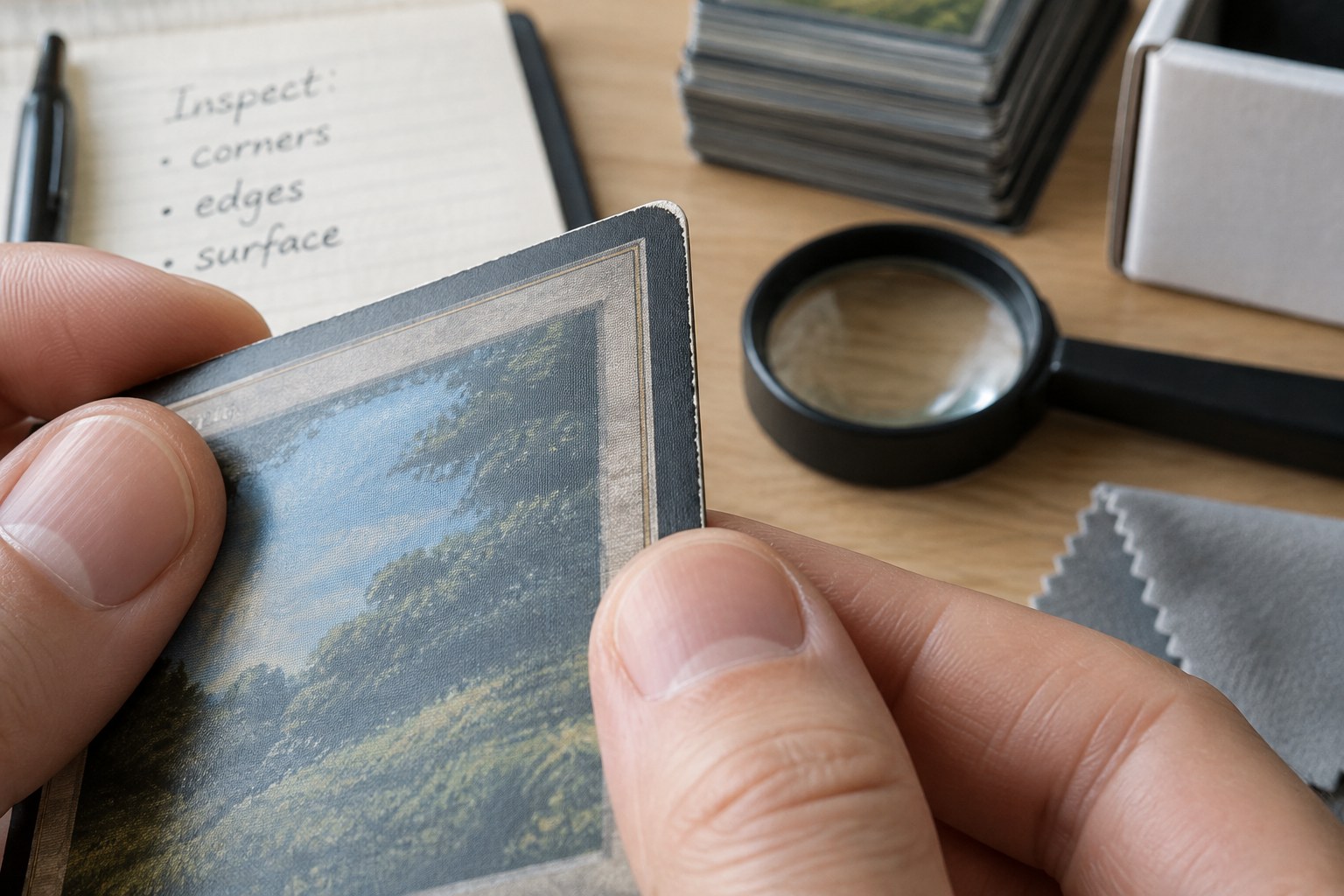
Use a consistent order, such as upper left, upper right, lower right and lower left as viewed from the front. Note visible softening, bends, missing material or separated layers. Describe size and location only as precisely as your view allows. A magnified image can make a small feature look dramatic, so keep an overall photograph alongside it.
Check the corresponding corner from the back when possible. A front image alone can miss a fold or a change in colour on the reverse. Avoid touching a corner to find out whether it is raised; observation should not become a test that creates further wear.
Follow edges and then the surface
Inspect each edge for visible chips, roughness and interruptions in the printed colour. Separate a naturally printed border from an area where material appears missing. If you cannot tell which you are seeing, record the uncertainty and obtain a clearer photograph rather than inventing a confident explanation.
For the surface, use an additional gentle change of light angle to reveal reflections. Keep the original neutral view too. Record visible lines, dents or patches without attributing a cause that you cannot establish. Do not rub the surface, apply moisture or use a fingernail to test whether a mark can be removed.
Write a description that matches the evidence
Combine the observations into a short account with image references. For example, identify a small pale area on the lower reverse edge and point to the matching detail photo. Avoid replacing observations with terms such as perfect or flawless, which imply a level of certainty the inspection may not support.
Date the notes and say whether the card was viewed loose, sleeved or encapsulated. Keep the original image files so later questions can be compared with the same evidence. If the decision depends on professional grading or authenticity, use an appropriate independent service rather than treating this visual checklist as a substitute.