Reviewing encapsulated cards before purchase
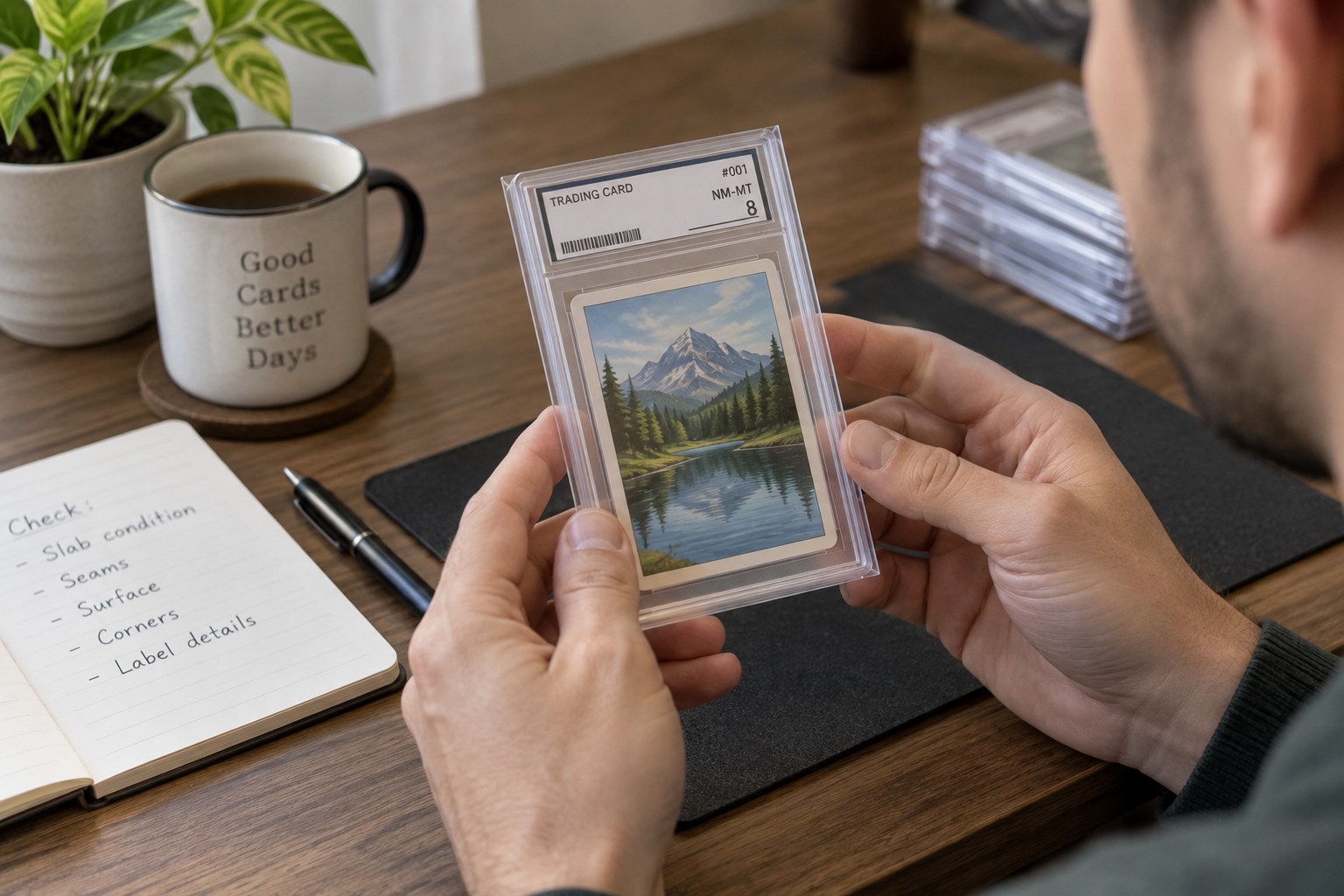
An encapsulated card comes with two things to examine: the card and the holder's identification. A certification number is a starting point for verification, not a replacement for checking the actual offer.
Identify exactly what is being offered
Save the listing and read the label in a clear photograph. Record the grading company, certification number, card name, set, year, language or variation where shown, and the stated grade. Compare these details with the seller's title. A title may abbreviate information or contain an error that becomes apparent only when the label is readable.
Ask whether the photographs show the exact holder to be supplied. Generic images are inadequate when the decision depends on the individual card, the label or the holder's condition. Request front and back views with enough resolution to inspect the whole enclosure, plus relevant close-ups. A cropped label alone does not show which card sits beneath it.
Use the issuer's own verification service
Navigate independently to the grading company's official verification page and enter the number. Compare the returned description with the photographed label and card. Where official images are available, compare visible details rather than stopping at the existence of a record. Save the date of the check and note any discrepancy you have not resolved.
PSA explicitly warns that counterfeit documents can use certification numbers taken from public sources. Consequently, a number returning a genuine record does not by itself establish that the holder offered is genuine. Verification is one part of the evidence. If a record is unavailable, inconsistent or flagged, ask the issuer for guidance before making a purchase that depends on that certification.
Look at the holder without treating it as proof
Examine photographs for visible cracks, chips, heavy scratches, separation or other damage. Ask for a different angle where glare hides an edge. Do not turn a photograph into a diagnosis of tampering: explain the feature you see and the question it raises. Equally, a clean-looking enclosure is not enough to prove that nothing has been altered.
Distinguish holder damage from card damage. A line crossing the plastic may be outside the card, while a defect within the card may be difficult to see through reflections. Ask the seller to clarify which surface is affected. If the answer remains uncertain, retain that uncertainty in your decision instead of assigning the more favourable explanation.
Understand what the label does and does not answer
Read the issuer's description of its grading and authentication services for the relevant type of item. Do not assume that every label certifies every possible claim, such as the origin of a signature or an attached memorabilia element. Separate the label's wording from additional claims made by the seller.
Consider whether the encapsulated format suits your intended use. If you want to handle both sides directly or place the card in an ordinary binder, removing it is a consequential decision. Check the issuer's rules before buying with that intention; PSA states that removal or signs of holder tampering invalidate its certification. Do not plan a purchase around retaining a certification after changing the enclosure yourself.
Make unresolved questions part of the decision
List what you have confirmed, what depends on the seller's statement and what remains unknown. A complete official record, clear photographs and consistent details provide a better basis for a decision than a grade alone. They still do not create a guarantee from this website or from your own visual inspection.
Keep the listing, verification record and correspondence together if you proceed. Compare the received holder against those records before filing it into storage. If identity or condition differs, preserve the packaging and contact the seller through the agreed transaction channel. Avoid opening or modifying the holder while trying to resolve a discrepancy.