Separating used and unused stamps
Used and unused are useful starting categories, but a stamp’s visible front does not always settle its history. Keep descriptive details alongside the broad label.
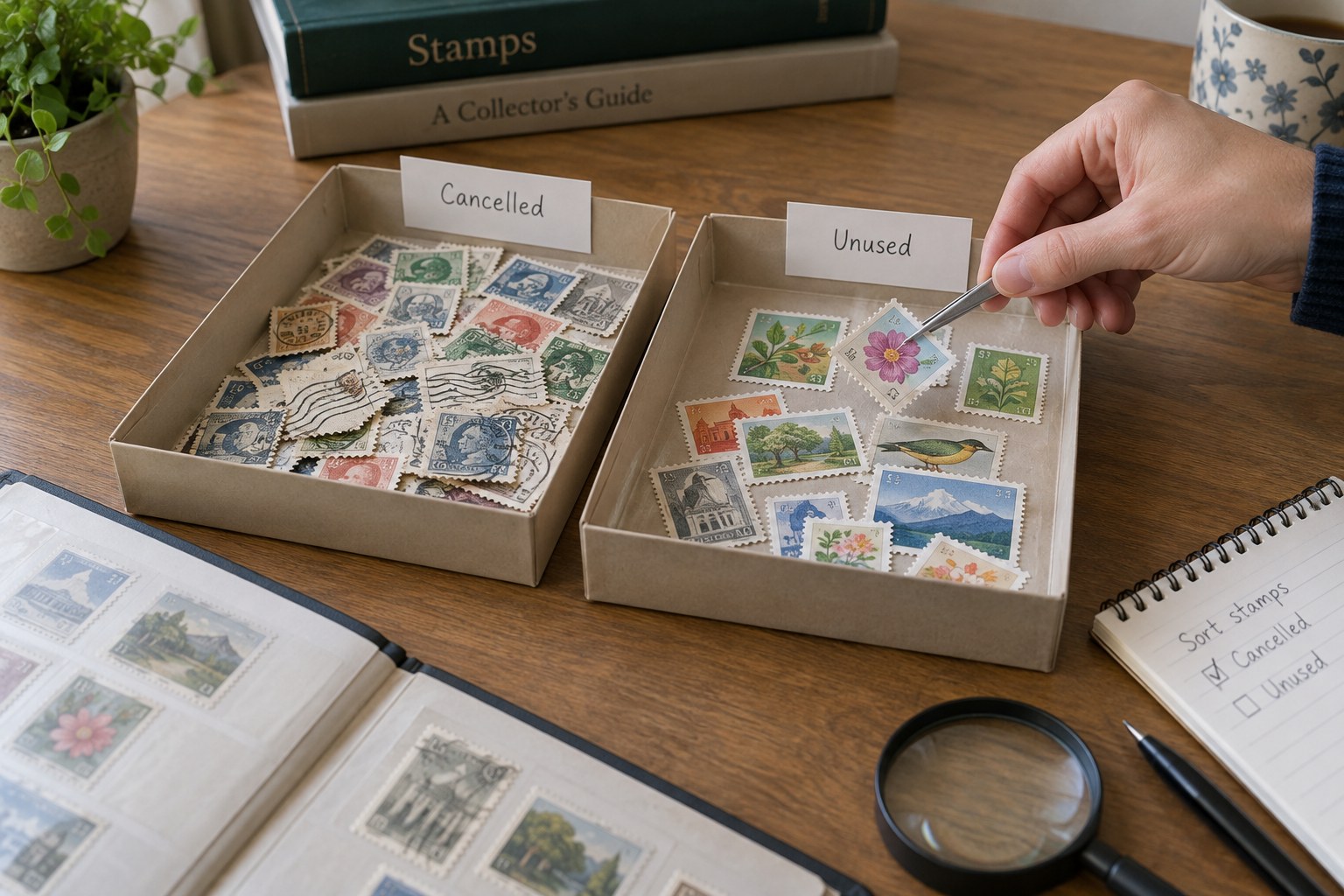
Record evidence before selecting a category
Examine the stamp’s front for a cancellation or other visible marking and record what you can read. An unclear mark should not be silently treated as absent. Keep an image of the full stamp and a closer view where needed. If the stamp remains attached to a cover, preserve the whole object and describe the postal context rather than removing the stamp to fit a sorting system.
An unused-looking front does not tell you everything about the reverse. Record whether the back is visible and whether you can observe gum, a hinge remnant or another attachment. Do not remove an attachment or wet the stamp to make the classification easier. Use wording that describes the evidence available rather than assuming that unused means a particular gum condition.
Choose labels that preserve distinctions
Keep separate fields for broad use status, cancellation description and reverse observations. This lets you group the collection without losing details that matter to later comparison. A simple status such as uncertain can be more accurate than forcing every example into one of two finished categories. Define your terms in a short note so future entries remain consistent.
If you use catalogue or seller terminology, record its source and check what it means in that context. Do not copy a desirable abbreviation from another listing simply because the designs match. The label must describe the actual example. For inherited or previously mounted material, the treatment and mounting history may remain unknown even after careful visual examination.
Organise without rewriting provenance
You can place used and unused examples in separate pages while retaining their shared purchase or original album reference. Give each piece an ID before moving it, and photograph the former arrangement when it carries useful context. If a pair belongs together for a comparison of design and cancellation, link their records rather than relying solely on neighbouring positions.
When offering a stamp for sale or exchange, include the front, the accessible reverse and the limitations of examination. Describe visible marks and attachments in ordinary language alongside any category. A buyer can then understand why you selected that category and what remains uncertain. Classification should make the evidence easier to find, not hide it behind a short word.


